
Does KTRL Increase Testosterone or Male Libido?
What KTRL can and cannot claim about hormones, sexual desire, and sensory experience.
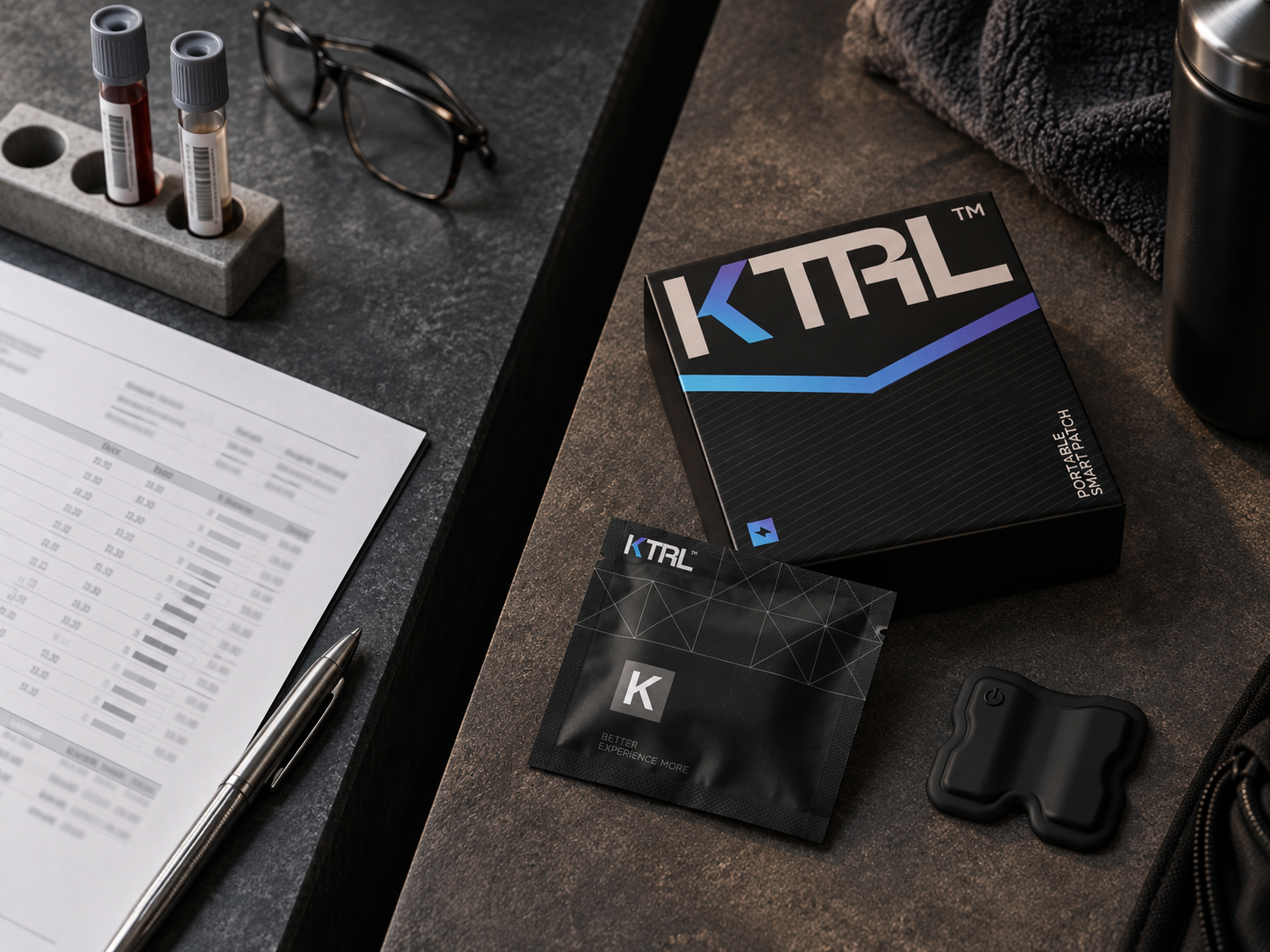
KTRL WDC201 is a single-use sensory patch, not a testosterone treatment. The product materials linked below do not establish that KTRL increases testosterone or your usual level of sexual desire. Enjoying a different physical sensation during one use does not measure hormones or demonstrate a lasting libido change. A persistent or distressing change in desire deserves an assessment of the concern itself.
By KTRL | Updated:
Testosterone, libido and sensation are different
A hormone level, interest in sexual activity and a physical feeling describe different things. Separating them helps you ask the right question about a product or a health concern.
Testosterone is a hormone
The Endocrine Society's patient guidance explains that testosterone contributes to sex drive, sperm production, bone health and male physical characteristics. Its role in sexual health does not mean every change in interest is caused by testosterone.
Libido is interest in sexual activity
Libido concerns desire or motivation, rather than one erection or the intensity of one sensation. The European Association of Urology (EAU) guidance on low sexual desire describes psychological, relationship, medicine-related, health and endocrine contributors.
You can want a different sensation without having a hormone concern. You can also have reduced interest that deserves advice even when physical sensation is unchanged. The comparison of desire, arousal and sensation explains these distinctions further.
Sensation is what you physically feel
An experience can feel different, interesting or enjoyable without establishing an enduring increase in desire. Subjective excitement, erections, physical sensation and consent should be considered separately; none is a blood testosterone measurement.
Does KTRL increase testosterone or libido?
The available product materials support KTRL's description as a sensory product, but do not establish an increase in testosterone or baseline libido. This is a limit of the evidence available here, not a claim that KTRL has never been studied or proof of a biological effect in either direction.
| Question | What the available information supports | What it does not establish |
|---|---|---|
| Does KTRL raise testosterone? | The linked product documents do not demonstrate a testosterone increase. | A measured hormone effect. |
| Does KTRL increase baseline libido? | The linked documents do not demonstrate a lasting increase in usual sexual desire. | A treatment for reduced desire. |
| Does KTRL add physical sensation? | Its described function is rhythmic physical sensation through external skin contact. | That the sensation changes hormones or treats a sexual-health condition. |
| Can my response diagnose low testosterone? | A personal response can describe an experience. | A hormone level or a diagnosis. |
What evidence would support a hormone or libido claim?
A testosterone claim needs product-specific human research measuring that hormone outcome with appropriate methods, a defined protocol, a suitable comparison and transparent reporting. A sustained libido claim needs evidence assessing desire over the relevant period. A report of stronger sensation during one use does not measure either outcome.
Research on another electrical-stimulation device, a patent, a product description or an anecdote cannot establish the same effect for KTRL. An electromagnetic compatibility (EMC) document addresses its stated technical scope; it is not evidence of a hormone or libido effect.
Product documents you can check
These public documents let you identify the model, instructions and stated EMC scope. Their purpose is different from a clinical study measuring hormones or desire.
| Document | Version or identifier | What it covers |
|---|---|---|
| WDC201 user guide | The page states that it is based on the English 3c instructions, updated 22 May 2026, and confirmed website instructions. | Intended users, restrictions, handling, specifications and stopping rules. It is not a clinical efficacy study. |
| Displayed Verification of Conformity | No. ICR/VC/HM260653; model WDC201; trademark KTRL3F; issue date shown: 3 June 2026. | The document lists EMC under Directive 2014/30/EU. It does not establish medical approval or a testosterone or libido benefit. |
How low testosterone is assessed
Low testosterone is assessed through symptoms, clinical history and appropriate blood measurements together. A change in desire or a response to a sensory product cannot diagnose it.
Symptoms and repeated measurements belong together
The Endocrine Society's clinical guideline recommends diagnosing testosterone deficiency only when compatible symptoms or signs occur alongside unequivocally and consistently low testosterone concentrations. It recommends confirming the result with a repeat morning fasting total-testosterone measurement, using accurate assays and appropriate reference ranges.
Its patient guidance similarly describes at least two early-morning blood tests showing low testosterone, together with typical symptoms or signs. These criteria describe clinical assessment, not a self-test to apply after using KTRL.
Reduced interest, fewer spontaneous erections, reduced energy or other changes may be relevant to the discussion. They can also have other explanations. A clinician considers history, medicines, examination and results together rather than attributing one feeling to one hormone.
One result or an online threshold is not the whole assessment
Testosterone varies, and interpretation depends on the testing context and laboratory method. One reading or a threshold found online cannot replace the recommended assessment. The same guideline recommends against routine screening of men in the general population; a person seeking help for symptoms needs an individual clinical discussion.
Bring a brief description of when the change began, whether it persists, what troubles you and any relevant treatment or medicine changes. You do not need to request a particular diagnosis before seeking help. Do not start hormone treatment or change prescribed medicines based on a product response or this article.
Choose the next step for your concern
Persistent or distressing changes in desire call for professional advice. A separate, voluntary interest in added sensation does not answer the health question.
For a health concern, seek assessment
KTRL Portable Smart Patch, model WDC201, is a single-use consumer electronic product for external skin contact. It is not a medical device and is not intended to diagnose, treat, alleviate, monitor or prevent a disease or medical condition. It should not be used to investigate low testosterone, restore libido or postpone care.
The guide to stopping product experiments and seeking advice explains when emergency care, prompt advice or a planned appointment should take priority.
For added sensation, the product restrictions still apply
The intended wearer must be a man aged 18–60 inclusive, meet the product restrictions and be able to follow the printed instructions. Everyone involved must freely agree. The restriction and consultation guide covers do-not-use conditions, including treatments or medicines that may affect sensation, local reactions or safe-use judgement. Do not use the product while a restriction or an instruction remains unresolved.
Keep the same-use limit: at most 30 minutes of cumulative powered-on time. Switched-off intervals do not count; restarting continues the existing total. Track the total yourself.
Switch off before removal or adjustment: an adhesion or position adjustment belongs to the same use. Do not reuse the patch in a later session. Gentle bending to fit the skin is permitted; excessive bending or folding is not.
Stop for discomfort: if pain, stinging, burning, redness, swelling, itching or other obvious discomfort occurs, stop immediately, switch off and gently remove the patch. Do not reapply it to test tolerance after a reaction. If discomfort persists, discontinue further use and consult a qualified healthcare professional.
Stop if the product is abnormal or malfunctioning: contact KTRL Support about the product fault. Product support does not replace care for health symptoms.
The complete user guide provides the handling instructions. These rules govern product use; they do not make KTRL a hormone treatment.
Frequently asked questions
Can KTRL boost testosterone naturally?
The product documents linked here do not establish a testosterone increase. Calling an effect “natural” does not reduce the evidence needed to support it.
Does enjoying KTRL mean my libido has increased?
Enjoyment during one experience does not demonstrate an increase in your usual level of desire or a hormone change. It describes how that experience felt.
Does low desire prove that my testosterone is low?
No. Desire has several possible contributors. Diagnosing testosterone deficiency requires appropriate symptoms or signs and consistently low measurements, not low desire alone.
Can I try KTRL before deciding whether I need a blood test?
A response to KTRL cannot screen for testosterone deficiency or determine whether testing is needed. Discuss symptoms with a qualified healthcare professional, who can decide whether testing is appropriate.
References
Sources checked on . The Endocrine Society and EAU sources support the clinical context, not a KTRL hormone or libido effect. This article provides general information; individual testing and treatment decisions belong with a qualified healthcare professional.
Endocrine Society. Hypogonadism in Men. Patient resource; last updated 24 January 2022.
Endocrine Society. Testosterone Therapy for Hypogonadism Guideline Resources, dated 19 March 2018. Linked guideline: Testosterone Therapy in Men With Hypogonadism: An Endocrine Society Clinical Practice Guideline, published 17 March 2018, doi: 10.1210/jc.2018-00229.
European Association of Urology. Low Sexual Desire and Male Hypoactive Sexual Desire Disorder. Sexual and Reproductive Health Guidelines; clinical contributors and assessment.
KTRL. WDC201 user guide. The webpage identifies the English 3c instructions updated 22 May 2026 as its basis, alongside confirmed website instructions.
KTRL product documentation. Displayed Verification of Conformity, ICR/VC/HM260653. Issue date shown: 3 June 2026; stated EMC scope for WDC201.
Comments (0)
Please login to comment.
No comments yet.