Why Are Erections Different During Masturbation and Partnered Sex?
Why context changes sexual response and how couples can explore shared sensation without blame or comparison.
Erections can differ during masturbation and partnered sex, but that difference alone does not reveal the cause. Stimulation, control, expectations and emotions may differ between settings. A satisfactory solo erection does not rule out physical or medicine-related contributors to partnered difficulty. It also does not prove a lack of attraction, damage from masturbation or an entirely psychological problem. Describing the pattern can help you discuss it without blaming yourself or your partner.
By KTRL | Updated:
Erections during masturbation and partnered sex: what research found
Research has documented differences between these settings, but a finding across a group cannot diagnose why one person's erections vary. Neither of the studies below tested KTRL.
A study of 4,209 men found differences between settings
A 2021 multinational study by Rowland and colleagues compared sexual response during masturbation and partnered sex in 4,209 men, with and without sexual dysfunction. The published abstract reports consistently lower impairment during masturbation for the three problems examined: erectile dysfunction, premature ejaculation and delayed ejaculation.
The authors also state that the study did not provide an empirically established explanation for the difference. It documented a pattern; it did not show which factor caused an individual's difficulty. Its discussion of possible treatment implications should not be read as proof that copying a solo routine will resolve partnered difficulties.
A separate study of 3,586 men examined frequency and other factors
Another study by Rowland and colleagues, published online in 2022 and in a 2023 journal issue, examined pornography use, masturbation frequency and erectile functioning in 3,586 men. Its publisher abstract describes analyses that considered other relevant factors alongside those behaviours.
In the samples examined, pornography-use frequency was not significantly associated with erectile functioning or erectile-dysfunction severity. Masturbation frequency was only weakly and inconsistently related to those outcomes. Age, anxiety or depression, relevant chronic health conditions, low sexual interest and lower relationship satisfaction were more consistent correlates.
These are associations, not proof of cause. The findings do not mean pornography or masturbation can never matter to an individual, or that frequency alone captures every relevant aspect of either behaviour. They do not justify blaming either one without considering the wider history.
What may differ between the two settings
Control, attention and interpersonal context are useful details to describe, not explanations proven for everyone. The European Association of Urology guidance on erectile dysfunction recognises that physical and psychological contributors can coexist.
Control over pressure, pace and pauses
During masturbation, a person can adjust pressure, pace, pauses and contact immediately. Partnered activity also involves another person's preferences, movements and boundaries. A familiar routine may feel different from shared activity without either person doing anything wrong.
You can explain a preference, and a partner can decline a particular technique. An exact reproduction of a solo routine is not a requirement for a satisfactory shared experience.
Attention, privacy and expectations
A shared setting may bring thoughts about privacy, contraception, the other person's enjoyment or whether an erection will last. Some people notice more self-monitoring. These details may be relevant to an assessment, but noticing worry does not establish that worry caused the erection change.
For help naming the concern, read performance anxiety or timing concern: which problem are you trying to solve?
Emotions and the relationship setting
Closeness, conflict, uncertainty and fear of disappointing someone may change how a moment feels. One erection is not a reliable measure of attraction or relationship quality. A partner should not be made responsible for producing a particular physical response.
Describe the change and choose your next step
A clear description can help a partner or healthcare professional understand your concern. You do not need to diagnose yourself or reproduce the difficulty to justify asking for help.
Use observations rather than a score
This table is a reflection aid, not a test of sexual function, attraction or product suitability. Answer only what is relevant; the answers do not identify a single cause.
| Detail to describe | A question to answer in your own words |
|---|---|
| Onset | Has this always happened, or is it a recent change? |
| Context | Does it happen only during particular activities or across different settings? |
| Stimulation | What feels different about the pressure, pace or type of contact? |
| Expectations | Do you feel expected to maintain an erection, penetrate or reach orgasm? |
| Other changes | Is there pain, altered sensation, reduced interest or a recent medicine or health change? |
| Effect on you | Is the pattern distressing, recurring or causing you to avoid intimacy you want? |
Talk without treating the response as a judgement
You might say: “My response seems different in these settings. I do not want either of us to interpret that as a judgement. Can we talk about what feels comfortable and what we actually want to do?”
You can also name a boundary: “I would like to pause without treating it as a failure.” These are communication prompts, not a treatment shown to improve erections. Either person can decline an activity or change their mind.
Know when the pattern deserves professional advice
Seek qualified assessment if the difference is recurring, worsening, distressing or part of a broader change. A sudden change, pain, abnormal sensation or a change following an injury, treatment or medicine also deserves appropriate healthcare advice. A satisfactory response in one setting does not settle those questions.
NIDDK guidance on diagnosing erectile dysfunction describes medical, sexual and mental-health history, a physical examination and tests when appropriate. Tell the professional about the context difference and any other changes. Do not stop or change prescribed medicine on your own.
The guide to stopping product experiments and seeking professional advice explains why another trial should not replace assessment of an unresolved concern.
Where KTRL fits in this discussion
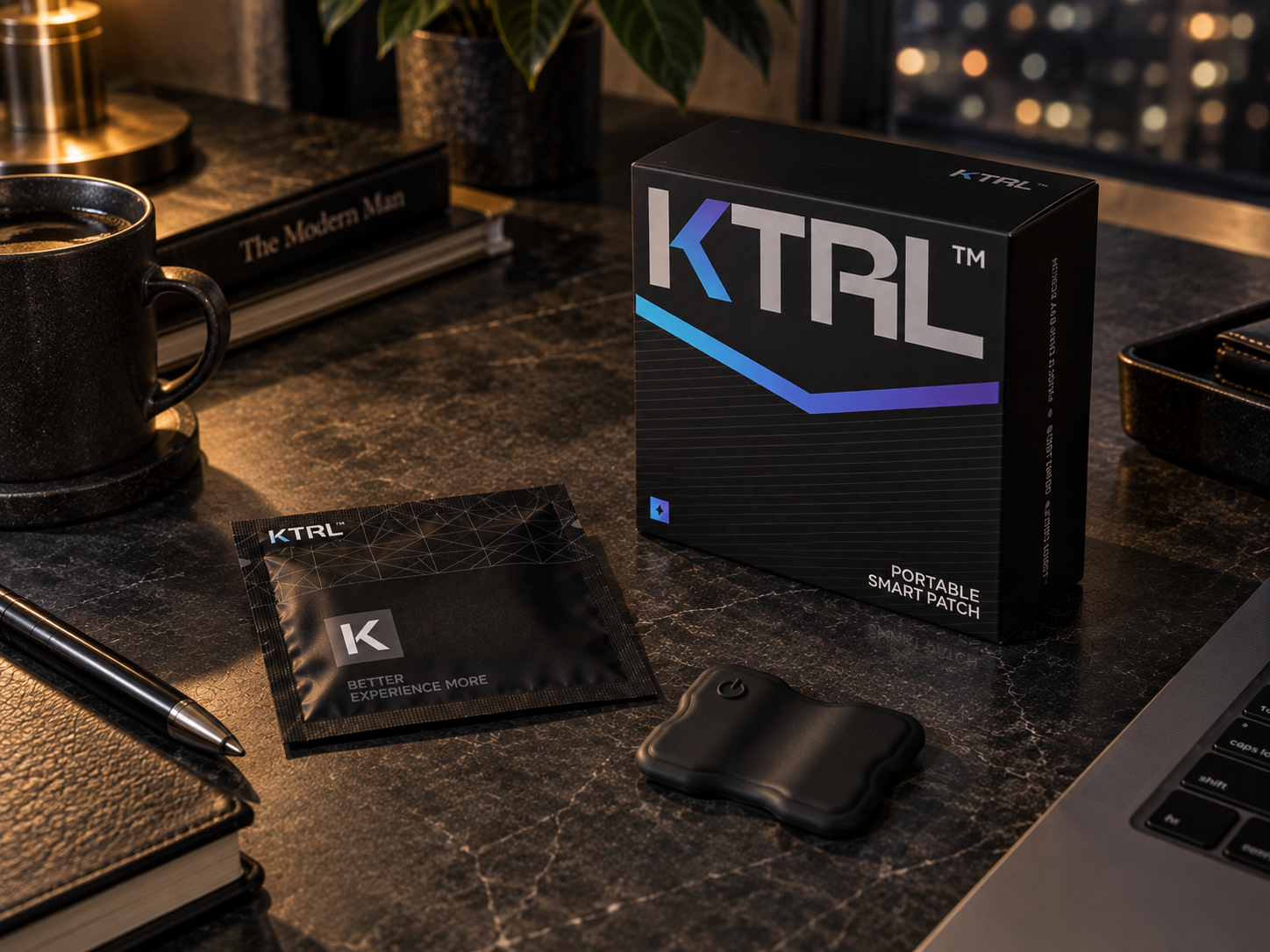
KTRL Portable Smart Patch, model WDC201, is a single-use consumer electronic product that adds rhythmic physical sensation through external skin contact. An interest in that sensation is separate from seeking help with an erection concern.
Keep a sensory preference separate from an erection test
Product evidence available for WDC201 does not establish that it creates or maintains an erection, makes a solo response transfer to partnered sex or treats anxiety. KTRL is not a medical device and is not intended to diagnose, treat, alleviate, monitor or prevent a disease or medical condition.
Do not use the patch to test your erectile response or delay assessment of a recurring or distressing change. Consent to discuss a product does not mean consent to use it.
Follow the restrictions and stopping rules
The intended wearer must be a man aged 18–60, inclusive, meet the product restrictions and be able to follow the printed instructions. Everyone involved must freely agree and remain free to stop. Check the suitability and use restrictions; an unresolved restriction or instruction prevents use.
The KTRL user guide lists peripheral nerve abnormalities or abnormal sensation as do-not-use conditions. Do not use the patch to investigate numbness or another sensory change.
Track the same-use limit: no more than 30 minutes of cumulative powered-on time. Switched-off intervals do not count, and restarting continues the existing total. Track that total yourself.
Switch off before adjustment: a permitted same-use position or adhesion adjustment requires switching off before removal and reattachment. It does not allow reuse in a later session. Gentle bending to fit the skin is allowed; excessive bending or folding is not.
Stop for discomfort: pain, stinging, burning, redness, swelling, itching or other obvious discomfort means stop immediately, switch off and gently remove the patch. Do not reapply it to test tolerance. If discomfort persists, discontinue further use and seek qualified advice.
Stop for a fault: do not continue with an abnormal or malfunctioning product; contact support. Product support does not replace healthcare advice about symptoms.
Frequently asked questions
Does a better erection during masturbation mean I am not attracted to my partner?
No. The difference does not establish a lack of attraction. Contextual and health factors may be relevant, and an erection is not a verdict on the relationship.
Does it mean the difficulty is entirely psychological?
No. Anxiety may contribute, but physical, medicine-related and other factors can coexist. A context pattern is not a diagnosis.
Should my partner copy my masturbation routine?
You can explain preferences and ask what is comfortable for both of you. Your partner does not have to reproduce a routine exactly or accept an activity they do not want.
Can KTRL make my solo and partnered responses match?
Product evidence available for WDC201 does not establish that outcome. KTRL should not be used as an erection test or a treatment for the difference.
Sources
Rowland DL, Hamilton BD, Bacys KR, Hevesi K. Sexual Response Differs during Partnered Sex and Masturbation in Men With and Without Sexual Dysfunction: Implications for Treatment. Journal of Sexual Medicine. 2021;18(11):1835–1842. PubMed abstract.
Rowland DL, Castleman JM, Bacys KR, Csonka B, Hevesi K. Do pornography use and masturbation play a role in erectile dysfunction and relationship satisfaction in men? International Journal of Impotence Research. 2023;35:548–557; published online 15 July 2022. Publisher abstract.
European Association of Urology. Management of Erectile Dysfunction. Sexual and Reproductive Health Guidelines. Accessed 13 October 2026.
National Institute of Diabetes and Digestive and Kidney Diseases. Diagnosis of Erectile Dysfunction. Last reviewed October 2024; accessed 13 October 2026.
KTRL. KTRL Patch User Guide. Product purpose, restrictions and use instructions for WDC201. Accessed 13 October 2026.
The research and clinical sources provide background for understanding and assessing sexual response. They do not establish KTRL's effects or validate the reflection table as a diagnostic tool.
Comments (0)
Please login to comment.
No comments yet.