
Can Rhythmic Sensation Help You Notice Rising Arousal?
Using a steady sensory cue to track changes in arousal without turning it into a test
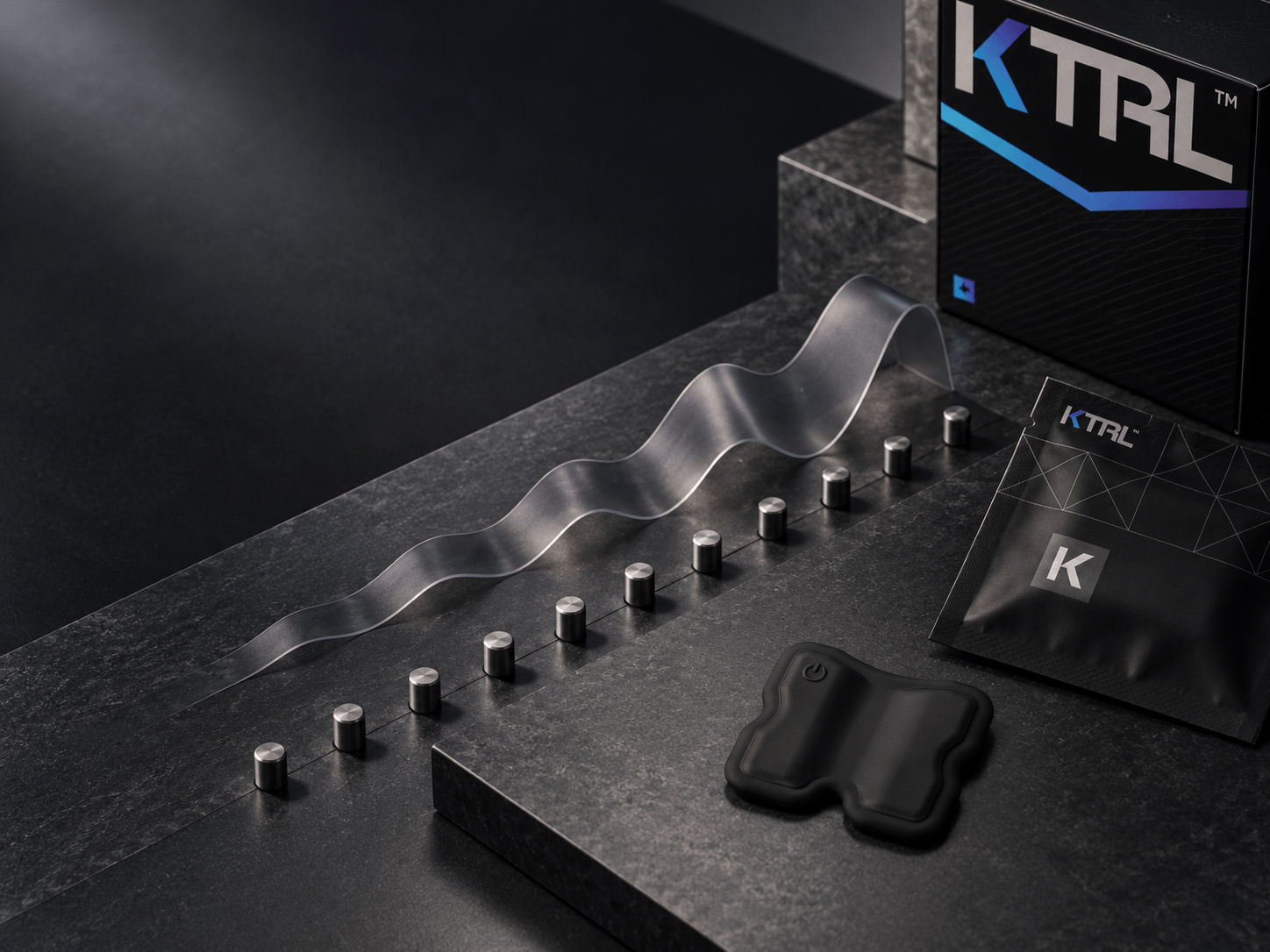
KTRL and arousal awareness are separate: noticing the patch's rhythm is personal observation, not an arousal measurement or validated training. The KTRL Portable Smart Patch, model WDC201, creates rhythmic physical sensation through controlled electrical pulses and external skin contact. It does not detect when you are close to ejaculation, choose a pause or confirm that continuing is safe. You may notice the cue alongside other feelings or decide not to focus on it. Your comfort, consent and the product instructions take priority.
By KTRL | Updated:
KTRL and arousal awareness: a sensation is not a reading
Noticing the repeating cue tells you about your sensation at that moment. It does not give you an arousal reading or a reliable threshold for ejaculation.
How strong, clear or distracting the rhythm feels should not be interpreted as a low, medium or high clinical zone. The patch is not a warning system for impending ejaculation, and a change in how you experience it does not tell you whether it is safe to continue.
You can notice a change without changing what happens next. You can also choose a pause without a patch or a detailed body-awareness exercise. Neither observation alone establishes improved awareness, control or ejaculation timing.
Optional prompts for noticing your experience
These questions can be used to describe an experience and your preferences. They are optional prompts, rather than a scored test, a clinical scale or a sequence you must complete.
| Moment | Optional question | What the answer means |
|---|---|---|
| While comfortable | What do I notice about the rhythm and the rest of the experience? | Your description of the moment. |
| If your experience changes | Do I want to continue, change activity, pause or stop? | A preference and choice, rather than a measured arousal level. |
| Afterwards | Did paying attention feel useful, neutral or distracting? | Whether you want that noticing routine again. |
There is no validated KTRL score, required sequence or promised progression towards better control. You do not have to monitor the feeling or complete an exercise. If attention becomes distracting or pressurised, stop the observation; you can also finish product use if you no longer want the sensation.
Afterwards, you might consider whether the cue drew attention away from other sensations or whether you preferred not to focus on it. Either answer is useful for describing your preference. You do not need to report an improvement or compare yourself with anyone else.
Pauses remain your choice
If you want a pause, choose one. The rhythm does not need to change first, and the patch does not select a pause or give permission to continue.
In a shared experience, all adults involved must remain free to pause, change an activity, stop or withdraw consent. A cue should never become a reason to override a stated preference. Agreeing to start does not create an obligation to finish an exercise or resume afterwards.
For operating rules during pauses, read KTRL with pacing, pauses and stop-start routines. For the separate evidence question about ejaculation timing, see sensation versus longer duration.
Product-use limits still come first
An observation exercise does not make an otherwise unsuitable product appropriate. KTRL is intended for adult men aged 18-60, inclusive, and all contraindications and use restrictions still apply.
Read the complete supplied instructions and KTRL user guide before use. Check who KTRL is designed for and its use restrictions. Do not use it when a do-not-use condition applies, consent is missing or the instructions cannot be followed.
Stop for discomfort
Pain, stinging, burning, redness, swelling, itching or other obvious discomfort requires stopping immediately, switching off and gently removing the patch as directed. If symptoms persist, discontinue further use and seek qualified professional advice.
Do not try to become accustomed to discomfort as part of an awareness exercise or reattach the patch to test your tolerance. Stop for an abnormal or malfunctioning product and contact KTRL Support; product support does not replace care for persistent symptoms.
Count cumulative powered-on time
The maximum is 30 minutes of cumulative powered-on time during the same use. This is a limit, not an exercise duration or a target. Switched-off time is excluded, and restarting continues the previous total. Keep track of the powered-on total yourself.
You can finish earlier. Ending the observation does not switch the product off: follow the instructions for switching off, removal and disposal. KTRL is single use and cannot be saved for a later session, even if this session was short.
When to seek sexual-health advice
Unwanted ejaculation timing that keeps occurring, causes distress or changes suddenly deserves qualified advice. A personal observation routine does not replace assessment of the pattern and possible contributing factors.
The NHS guide to ejaculation problems recommends seeing a GP for a persistent ejaculation problem. MedlinePlus information on premature ejaculation describes assessment involving sexual and medical history and a physical examination. You do not need to complete a product experiment before discussing a concern.
KTRL is not a medical device and is not intended to diagnose, treat, alleviate, monitor or prevent a disease or medical condition. Ordinary observation can describe your experience; it should not be presented as proof of improved awareness, control or timing.
Frequently asked questions
Can KTRL improve arousal awareness?
You may notice its rhythmic sensation alongside your own experience, but that observation does not establish improved arousal awareness. The cue is not an arousal measurement or validated awareness training.
Can the rhythm warn me before ejaculation?
No. The patch does not detect when you are close to ejaculation. How strong, clear or distracting the cue feels is not a reliable threshold or a warning to rely on.
Do I have to follow the prompts in order?
No. You can consider one question or none. There is no required sequence, clinical zone, validated KTRL score or progress target.
Should I wait for the rhythm to change before pausing?
No. Choose a pause or stop when you want one, or when comfort, consent or the instructions require it. No change in the cue is needed first.
What if paying attention feels distracting or pressured?
Stop the observation. You can also end product use if you no longer want the sensation, following the switching-off and removal instructions. Discomfort requires immediate stopping and removal as directed.
Sources
NHS. Ejaculation problems. Advice about persistent ejaculation concerns. Page last reviewed 9 February 2023; accessed 14 October 2026.
MedlinePlus, US National Library of Medicine. Premature ejaculation. General health information and professional assessment. Review date 1 January 2025; accessed 14 October 2026.
KTRL. KTRL Patch User Guide. WDC201 purpose, restrictions, single-use status and cumulative powered-on time. Accessed 14 October 2026.
The clinical sources provide general health context. KTRL's instructions provide the product-use rules; neither establishes a KTRL awareness-training or ejaculation-timing benefit. The questions above are ordinary observation prompts, not a clinical protocol.
Comments (0)
Please login to comment.
No comments yet.