
Body image and sex can become linked when checking how you look takes attention away from comfort, desire and pleasure. You do not have to love every part of your appearance to deserve respectful intimacy. A useful starting point is to notice the checking, make room for your own preferences and distinguish feared judgement from actual disrespect.
Updated:
How body image can affect sex
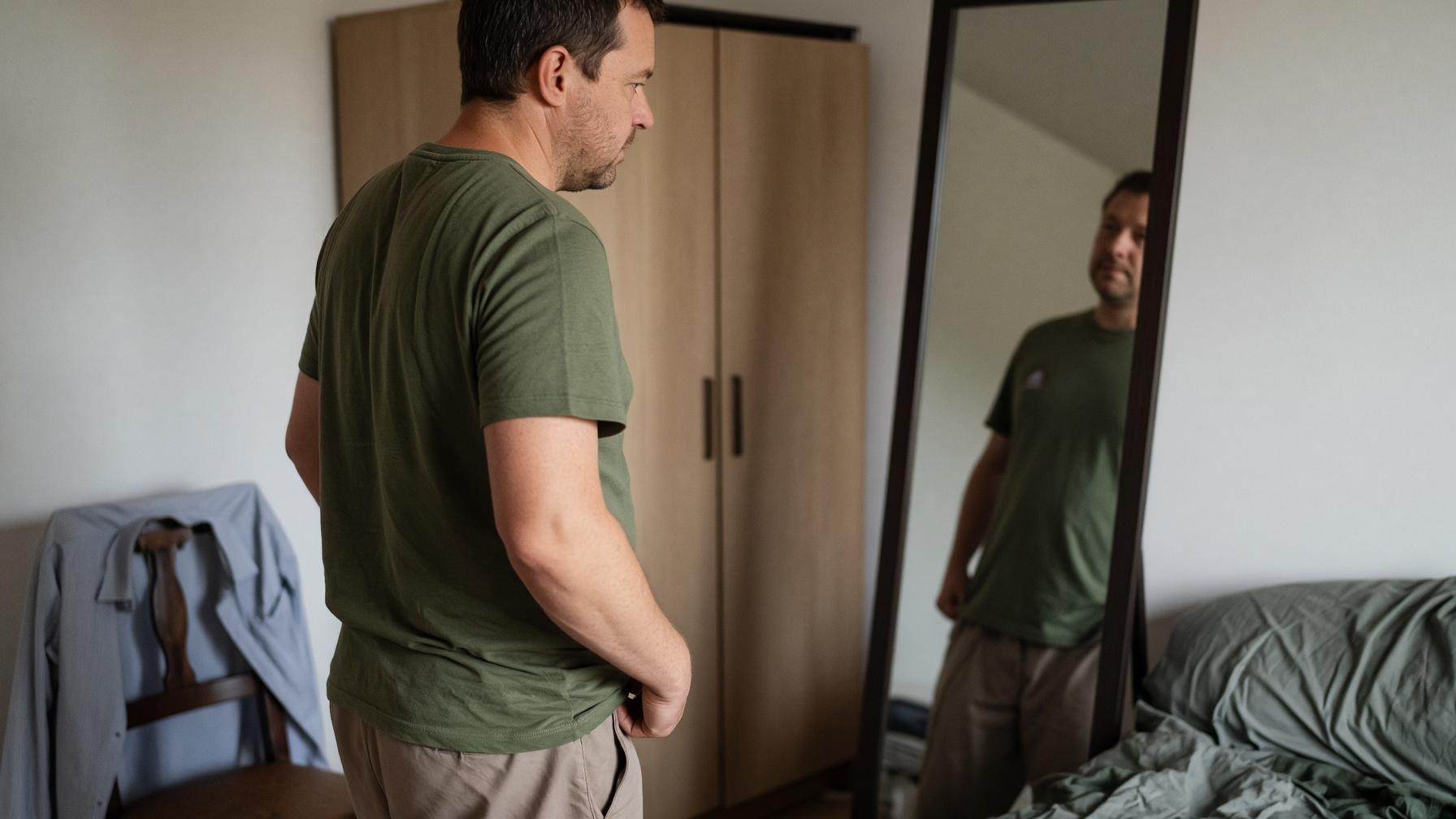
Appearance worries can divide your attention between experiencing contact and supervising how you look. A hand rests on your waist, but your attention goes to your stomach. You change position to hide an angle or pull at the bedding while wondering what your partner has noticed.
Intimacy can make the body feel exposed: clothes move, expressions change and you cannot control every view. If you already feel uncertain about an aspect of your appearance, that uncertainty may become especially noticeable.
Separate what happened from what you think it means
A partner looking at you does not tell you what they are thinking. A pause does not, by itself, establish disappointment. Your discomfort is real, but the explanation your mind supplies may still be uncertain.
| What happened | What you may assume | What you can express |
|---|---|---|
| The light came on. | “They must dislike what they see.” | “I feel exposed. I'd prefer softer lighting.” |
| Your partner paused. | “They are disappointed in my body.” | “Can we check in about how we're both feeling?” |
| Your partner made a weight-related joke. | “I should learn to take it.” | “Comments about my weight affect me. Please stop.” |
The last example involves an actual comment, not just an imagined judgement. Repeated ridicule, comparisons or pressure to change your body should not be reduced to a private confidence problem for you to solve.
What research says about body image and intimacy
Research links greater body self-consciousness during intimacy with lower sexual satisfaction. These associations do not prove that an appearance worry caused a particular difficulty or that changing your body will resolve it.
A study of 201 Dutch men
Van den Brink and colleagues examined attitudes towards muscularity, body fat, height and genitals in a cross-sectional survey published online in 2017. The 201 participants also reported body self-consciousness during physical intimacy and sexual dissatisfaction.
Negative body attitudes and greater body self-consciousness were associated with sexual dissatisfaction. Statistical modelling suggested that self-consciousness helped account for the associations involving muscularity, body fat and genitals. Because the data were collected at one time, the study could not establish the direction of causation. Its heterosexual, mainly young and highly educated sample did not represent all men.
A study of 368 US college women
In a 2014 study in Body Image, Claudat and Warren examined body surveillance, body shame, self-consciousness during sexual activity and sexual satisfaction in 368 US college women. The self-report findings linked body shame and self-consciousness with lower sexual satisfaction.
The analysis was consistent with a connection between monitoring appearance, feeling self-conscious during sex and reduced satisfaction. It did not test whether a particular coping exercise or appearance change improves sex.
The shared point is that how you relate to your body deserves attention alongside how it looks. These studies do not establish a required body shape, a diagnosis or a guaranteed solution. Their specific samples also limit how far the findings can be generalised.
Making room for comfort without forcing confidence
You can prioritise comfort and respect without feeling positive about every part of your appearance. If “love your body” feels like another demanding task, a more neutral approach may be easier to try.
For example, replace “My legs look wrong” with “I want a position where my legs feel comfortable.” The aim is to give attention a practical direction, rather than argue with every appearance thought.
Try one small, reversible adjustment
Before contact: choose lighting, clothing or a kind of affection that feels comfortable. Discuss the choice with your partner; you do not need to prove trust through nudity or brighter lights.
When checking takes over: notice it without criticising yourself. If you want to continue, gently return attention to warmth, pressure, a partner's words or your own preference.
If something feels wrong: pause, change position or stop. “Is this comfortable for me?” is a more useful question than “Do I look comfortable enough?”
Afterwards: discuss what felt good or what you would like to change. Try not to turn the conversation into a detailed inspection of every look or angle.
These are optional ways to explore comfort, not a treatment programme or a test to pass. A preference for dim lighting is not automatically a problem. Consider whether your choices remain flexible and your own, or whether fear is increasingly restricting closeness you would otherwise want.
Allow confidence to vary
Feeling more exposed after illness, a change in weight or an unkind comment does not erase occasions when you felt comfortable. You can adapt to how you feel today without deciding what your future sex life must be like.
You can also notice which media or conversations prompt repeated comparison and decide how much attention to give them. Personal fitness or appearance goals can coexist with this work, but you do not have to postpone respectful intimacy until your body changes.
Talking to a partner and knowing when to seek help
Explain what happens in the moment and ask for a specific response, rather than presenting a list of perceived flaws. A conversation outside sexual activity can give both people more room to listen.
“I sometimes get distracted by how I look. Taking things slowly helps me stay present.”
“Comments about my weight, even as jokes, stay in my head when we're close.”
“I'd rather hear what feels enjoyable than have my body compared with someone else's.”
“Please ask before taking any photograph or recording. Agreeing to intimacy does not mean agreeing to images.”
If your partner is the one feeling self-conscious
Listen without turning reassurance into an argument you must win. “You look fine” may be kindly meant, but it can leave someone trying to defend their distress. Ask what happens for them and which responses help. Keep compliments sincere and do not use them to push past a boundary.
A brief reassuring conversation can be helpful. If repeated requests to confirm that no flaw was noticed keep the inspection going, consider getting support for that cycle. If a partner keeps mocking, comparing or pressuring you after you have asked them to stop, seek support in deciding what you need from the relationship.
When appearance concerns need more support
Consider professional help when worries occupy substantial time, cause marked distress or lead you to avoid relationships you would like to have. The NHS explains that body dysmorphic disorder can involve persistent appearance worries, checking and effects on daily life. Occasional insecurity does not, by itself, mean you have this condition; a qualified professional can assess what is happening.
If concerns about weight or shape are disrupting eating or driving excessive exercise, seek healthcare advice. The NHS overview of eating disorders describes these as reasons to take the concern seriously. A mental health professional with experience in body image or sexual concerns can help you explore suitable support.
Body image and sex do not have to become a demand for perfect confidence. Your comfort, choices and preferences matter now, even while some insecurities remain.
Frequently asked questions
Can body image affect sex even when my partner is supportive?
Yes. You may anticipate judgement that your partner has not expressed, and appearance checking can still divide your attention. A supportive partner can listen to your preferences without trying to force confidence.
Do I need to change my body to feel more comfortable during intimacy?
The studies discussed here do not show that changing appearance resolves sexual dissatisfaction. You can explore comfort, communication and the habit of checking without waiting to meet an appearance goal.
Is it wrong to prefer dim lighting or to keep some clothing on?
No. Those can be personal preferences, and you do not owe anyone more exposure. If fear increasingly limits closeness you want, professional support may help you understand that pattern.
Does feeling self-conscious during sex mean I have body dysmorphic disorder?
No. One situation or occasional insecurity is not enough to make that diagnosis. Persistent, time-consuming worries, repeated checking or significant distress are reasons to seek an assessment.
Sources
Van den Brink F et al. (online 2017; journal issue 2018). Negative Body Attitudes and Sexual Dissatisfaction in Men: The Mediating Role of Body Self-Consciousness During Physical Intimacy. Archives of Sexual Behavior, 47, 693–701.
Claudat K, Warren CS (2014). Self-objectification, body self-consciousness during sexual activities, and sexual satisfaction in college women. Body Image, 11(4), 509–515. Europe PMC abstract record (JSON).