
Microcurrent, TENS, and NMES: What Is the Difference for Men's Health?
Microcurrent, TENS, and NMES: a terminology comparison
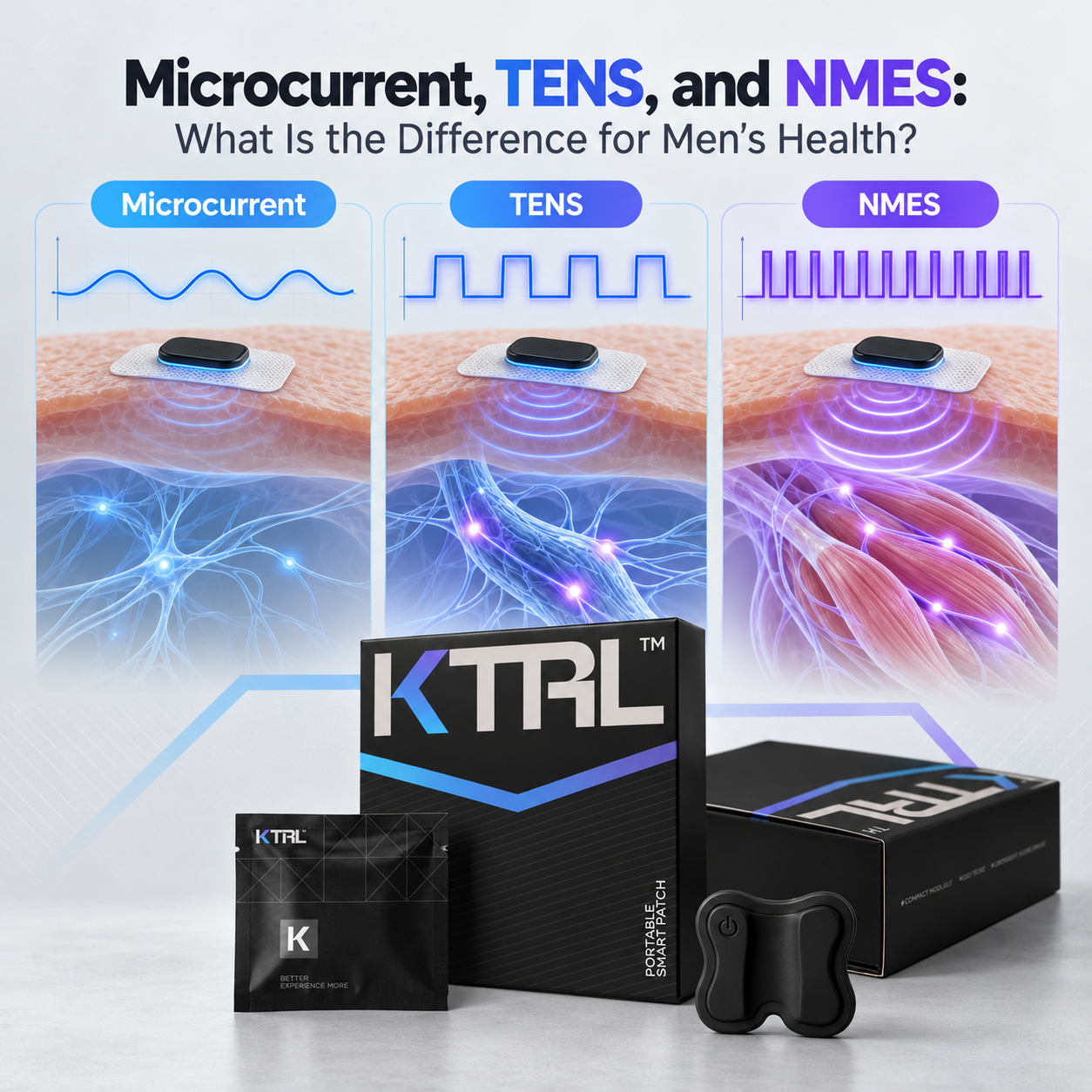
Microcurrent, TENS, and NMES: What Is the Difference for Men's Health?
Microcurrent describes a low-current electrical approach, TENS targets nerves through the skin, and NMES aims to activate muscles. These terms are not interchangeable, and none alone proves a benefit for men's sexual health. A device's intended use, electrical specifications, placement, and condition-specific clinical evidence matter more than broad wellness claims.
Microcurrent, TENS, and NMES: What Is the Difference for Men's Health?
Direct answer: Microcurrent primarily describes the magnitude of an electrical current. Transcutaneous electrical nerve stimulation (TENS) describes stimulation of nerves through the skin, commonly for pain relief. Neuromuscular electrical stimulation (NMES) describes stimulation intended to produce muscle contractions. They describe different aspects of electrical stimulation—not three interchangeable names for the same treatment. For men's health, the practical question is not simply whether a patch uses electricity. It is whether its intended use, output, electrode placement, and clinical evidence match the particular problem being addressed. A finding about exercise recovery or pelvic pain does not automatically establish a benefit for premature ejaculation or erectile dysfunction. The Physiological effects of microcurrent and its application for maximising acute responses and chronic adaptations to exercise. describes microcurrent as sub-sensory stimulation below 1 milliampere (mA). For unit conversion, 1 mA equals 1,000 μA. That is a description of current magnitude, not an established effective dose for men's sexual health. These labels can overlap in a device description because they do not classify exactly the same thing. Current amplitude is one property; the target and intended physiological response are others. A product name or the word “patch” does not resolve those distinctions. Two devices can both deliver electrical current through skin electrodes while using different stimulation protocols. Even two devices sold under the same broad category may not reproduce the same intervention. The microcurrent exercise review identifies variation in protocols as a major obstacle to interpreting the evidence and calls for reporting current intensity, frequency, application time, and treatment duration. This is why a shared technology label is not enough to transfer a study's findings to another device. Current amplitude, in μA or mA: how much current the device delivers. A marketing intensity level such as “level 3” is not a transferable electrical specification. Frequency, in hertz (Hz): the repetition rate of pulses, where pulsed stimulation is used. Pulse duration, in microseconds (μs) or milliseconds (ms): how long each pulse lasts. Microseconds measure time; microamperes measure current. Waveform: whether the output is continuous or pulsed, and how the electrical signal is shaped. Stimulation and rest periods: whether stimulation is continuous or alternates with pauses. Electrode size and placement: where and over what contact area stimulation is delivered. Session schedule: the duration of each session, frequency of sessions, and total course of use. Practical recommendation: If important specifications are missing, treat the device's relationship to published research as uncertain. Do not assume that “low frequency,” “microcurrent,” or “smart stimulation” supplies the missing details. No—not from the sources provided here. A plausible biological mechanism and a demonstrated clinical benefit are different types of evidence. The frequently discussed The effects of electric currents on ATP generation, protein synthesis, and membrane transport of rat skin. reported increased tissue adenosine triphosphate (ATP) concentrations and protein-related activity under particular experimental conditions. It investigated rat skin, not ejaculatory control or erectile function in men. ATP is involved in cellular energy processes. However, a change in ATP in an experimental tissue preparation does not establish improved sexual performance, a suitable treatment schedule, or the effectiveness of a consumer patch. Likewise, the microcurrent review focused on exercise-related responses in healthy, physically active people. Its discussion of candidate mechanisms and exercise adaptations should not be presented as clinical proof for treating premature ejaculation. Not automatically. A Sono-electro-magnetic therapy for treating chronic pelvic pain syndrome in men: a randomized, placebo-controlled, double-blind trial. studied a different intervention and a different condition. It did not find a statistically significant improvement over placebo in the primary overall symptom outcome. That result neither validates nor disproves every electrical stimulation device. It shows why the exact intervention, patient group, and outcome must stay attached to a research claim. “Men's health” is too broad to function as a treatment indication. Pelvic pain, premature ejaculation, and erectile dysfunction are different clinical problems. A claim about one should not silently become a claim about the others. Identify the intended use. Is the device intended for pain relief, muscle activation, or a specifically defined sexual-health outcome? Identify the tested population. Were participants men with the condition in question, rather than animals, healthy exercisers, or people with an unrelated complaint? Match the intervention. Check the device, electrical settings, placement, and schedule—not just the category name. Check the comparison and outcomes. Look for a suitable control, clinically relevant measures, follow-up, and adverse-event reporting. Separate immediate effects from lasting effects. A result during stimulation does not by itself demonstrate persistent improvement after use ends. For example, when assessing a wearable product such as the ktrlpatch portable smart patch, use this checklist rather than inferring effectiveness from its appearance or technology label. The supplied material does not independently establish its full electrical specifications or product-specific clinical efficacy. This mention is not a treatment recommendation. Practical recommendations: Read the device-specific instructions, intended placement, warnings, and contraindications. Do not copy electrode placement or settings from a study of a different device. If the documentation does not clearly authorize use on the intended body area, do not improvise. If you have a medical condition, an implanted electronic device, or uncertainty about whether stimulation is appropriate, seek advice from a qualified healthcare professional before use. “Non-invasive” and “drug-free” do not establish that a device is suitable for every person. This article explains terminology; it does not provide a stimulation protocol or establish that electrical stimulation is appropriate for a particular sexual-health concern. That shorthand is misleading. Microcurrent emphasizes current magnitude, whereas TENS describes nerve stimulation through the skin. Lowering an output does not establish an equivalent mechanism, clinical purpose, or treatment effect. No. Tingling is a sensory experience, not proof of muscle activation. NMES is intended to elicit contractions; sensation alone cannot verify its output specifications or effectiveness. Not necessarily: microcurrent is often described as sub-sensory. However, lack of sensation is not proof of a therapeutic effect either. Clinical outcomes—not sensation alone—are needed to evaluate benefit. No such conclusion follows from the evidence discussed here. More current is not a substitute for a validated protocol. Follow the device's instructions rather than increasing intensity to chase a result. Evaluate the intended use, technical specifications, and condition-specific evidence together. Microcurrent, TENS, and NMES are useful terms, but none is a stand-alone guarantee of better men's sexual health. Physiological effects of microcurrent and its application for maximising acute responses and chronic adaptations to exercise — a review relevant to microcurrent definitions, proposed mechanisms, and protocol variability. The effects of electric currents on ATP generation, protein synthesis, and membrane transport of rat skin — experimental tissue research, not a clinical sexual-health trial. Sono-electro-magnetic therapy for treating chronic pelvic pain syndrome in men: a randomized, placebo-controlled, double-blind trial — evidence about a distinct intervention for chronic pelvic pain.What does each term actually mean?
Term What it describes Usual intended response What the label does not establish Microcurrent A low-current electrotherapy approach, generally described in microamperes (μA). Often designed to operate below the threshold of conscious sensation. Which tissue is meaningfully affected or whether a specific health condition improves. TENS Transcutaneous electrical nerve stimulation: electrical stimulation delivered through the skin to nerves. Usually sensory stimulation in a pain-management context. That it trains muscles or treats an ejaculatory or erectile problem. NMES Neuromuscular electrical stimulation: electrical activation of motor nerves to elicit muscle contractions. Muscle activation for a defined therapeutic or training purpose. That the contractions improve sexual function or are appropriate for every pelvic-floor condition. Why aren't electrical stimulation devices interchangeable?
Which technical details should you check?
Does microcurrent research prove a sexual-health benefit?
Can another pelvic-health study fill that evidence gap?
What evidence matters for a men's-health device claim?
What should you do before using a stimulation patch?
Frequently asked questions
Is microcurrent just a weaker form of TENS?
Does a tingling sensation prove that a device is NMES?
If I cannot feel microcurrent, does that mean it is not working?
Does stronger stimulation mean better results?
What is the most important takeaway?
References
Comentarios (0)
Inicie sesión para comentar.
Todavía no hay comentarios.