

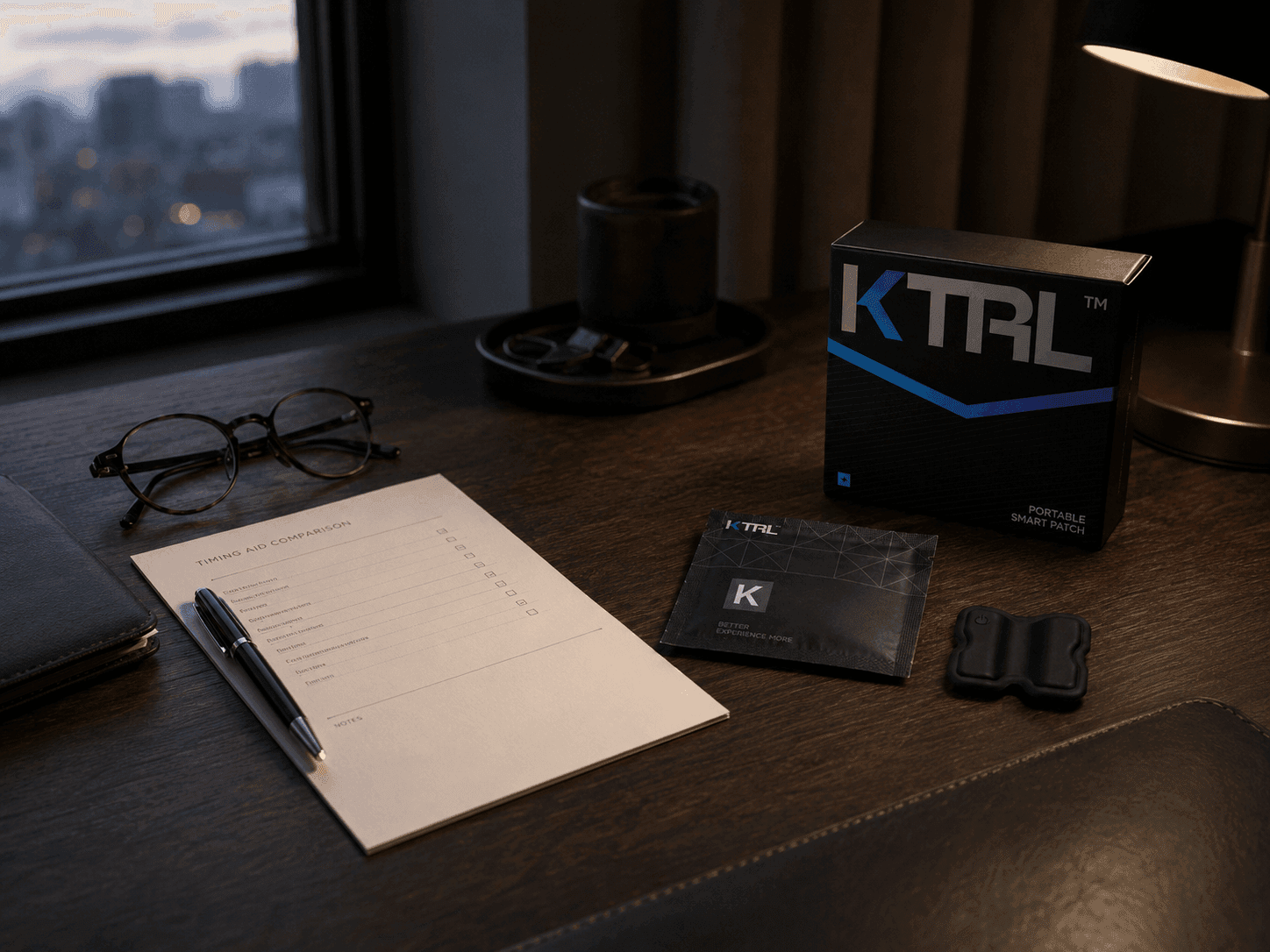
Choose a male timing aid by the goal it needs to serve: added sensation, reduced sensitivity, barrier protection or a recurring ejaculation concern. These are separate decisions. KTRL Portable Smart Patch, model WDC201, adds rhythmic physical sensation through external skin contact; that sensory role does not establish a delay in ejaculation. A product's name or a promise of extra minutes does not tell you whether it addresses your goal.
By KTRL | Editorial update:
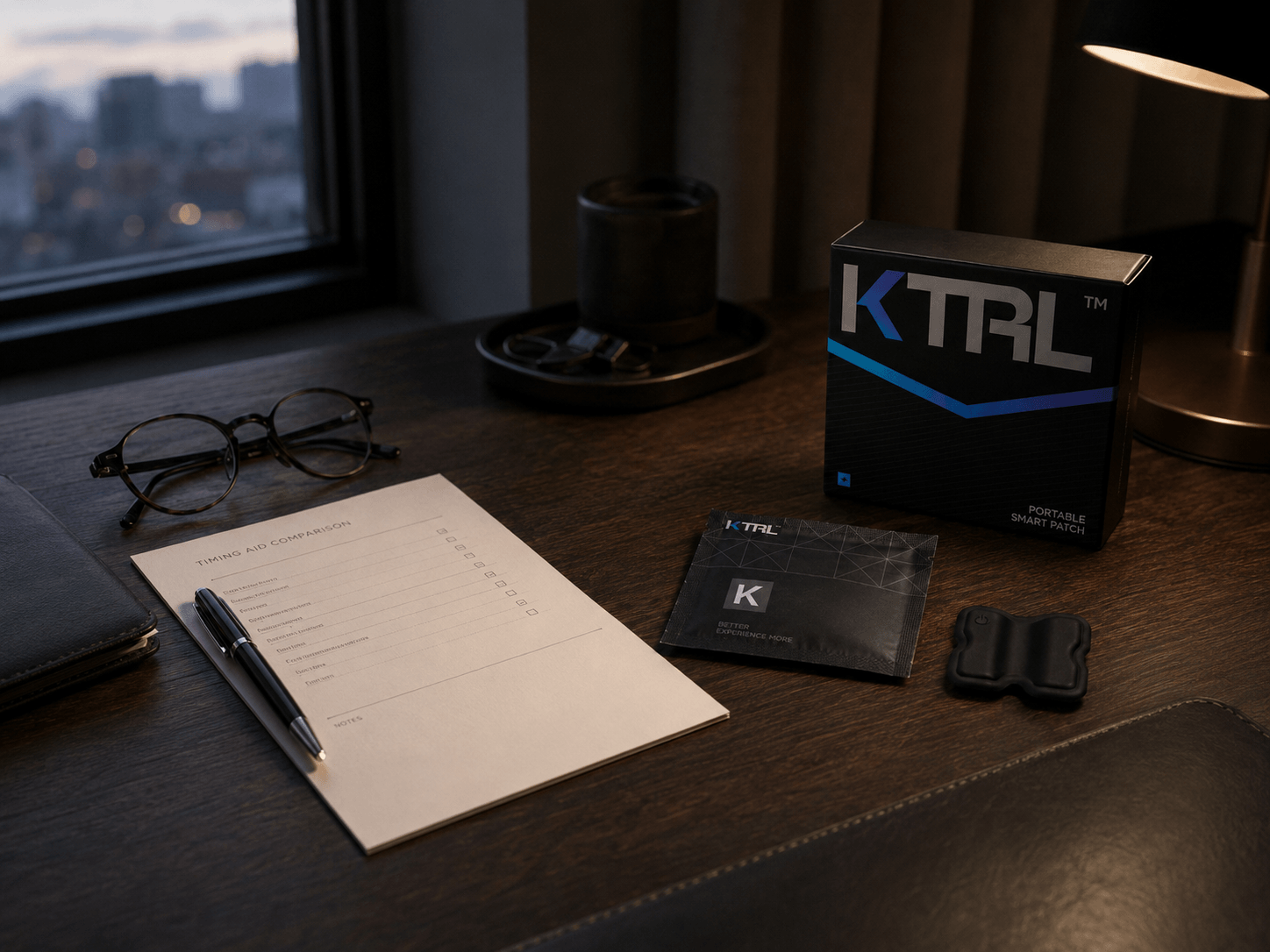
Choose a male timing aid by describing your goal
Start with what you want to change, rather than a product category. Sensory curiosity, a need for protection and a recurring health concern call for different questions. For a fuller comparison of formats, preparation and evidence, see KTRL, delay sprays and creams, condoms and medicines.
"I want a different physical sensation"
This is a preference question. Consider what would touch the skin, what preparation is required and whether the feeling itself interests you. You do not need to invent a disorder to justify curiosity.
The KTRL Portable Smart Patch uses controlled electrical pulses to create rhythmic physical sensation through external skin contact. Enjoying that sensation does not demonstrate delayed ejaculation. If longer duration is essential to your choice, read KTRL sensation versus expectations of lasting longer before choosing it for a timing goal.
"Ejaculation often happens earlier than I want"
Describe whether the concern is occasional or recurring, whether it has changed recently and whether it causes distress. The NHS guidance on ejaculation problems notes that occasional episodes are common and advises seeing a GP for a persistent problem.
The European Association of Urology guideline on ejaculation disorders considers timing alongside perceived control, distress and the pattern of the concern. A product quiz, a purchase or an arbitrary performance target cannot replace that assessment.
"I lose my erection or have little interest in sex"
Erection and desire concerns are different from ejaculation timing. A product described as a delay aid does not automatically address either one. Recurring erection problems or worrying changes in desire deserve their own healthcare assessment; see the NHS guidance on erection problems and low sex drive.
"I need contraception or STI protection"
KTRL provides neither contraception nor protection against sexually transmitted infections. Protection must be an explicit part of your decision. The patch cannot replace a suitable protective product or its correct use. The WHO condom fact sheet explains that correct and consistent condom use helps prevent unplanned pregnancy and most STIs. Check the chosen product's own instructions.
Match your goal to the next question
Use your starting point to decide what to ask next. You may have more than one goal, but a product fulfilling one role should not be assumed to fulfil another.
| Starting point | Useful next question | What to avoid assuming |
|---|---|---|
| Added sensation | Do I want this sensory format, and can I use it safely? | Enjoying a sensation proves a timing benefit. |
| Reduced sensitivity | What exact product, ingredients and label apply? | Every spray or cream has the same effects or warnings. |
| Barrier protection | Which protective product and instructions suit the activity? | A patch or delay formula supplies protection. |
| Recurring ejaculation difficulty | What pattern needs professional assessment? | A purchase establishes the cause or diagnosis. |
| Preferred pauses or slower pace | What routine do I want, without pressure to achieve a number? | Adding KTRL makes the routine clinically validated. |
This table organises decisions; it does not diagnose a condition or confirm that a product is suitable for you. If both protection and a different sensation matter, keep both requirements visible when comparing options.
Three checks before you compare formats
Once you have named your goal, check evidence, suitability and preparation. A convenient format is useful only if it fits the question you are actually trying to answer.
Evidence: ask what supports the exact product and result. Instructions establish handling rules; general research does not establish a KTRL timing benefit.
Suitability: check the exact product's warnings. KTRL is intended for men aged 18–60, inclusive; age alone is not clearance. Relevant skin, material-sensitivity, cardiovascular, implanted-device, nerve, medicine and recovery restrictions still apply. Read the complete suitability guide and resolve uncertainty before use.
Preparation: decide whether you can follow the instructions without improvising. An external patch, a topical product and a medicine have different handling and safety requirements.
For the category-by-category comparison of function, evidence and limitations, continue to KTRL, topical products, condoms and pills. For a medicine or a proposed combination, take the exact names and labels to a qualified clinician or pharmacist.
Make a decision without an extra-minutes target
A useful choice meets a goal you have chosen, with limitations you understand. For a sensory product, ask whether you want the feeling. For protection, the product must fulfil its protective role. For a recurring health concern, professional assessment may be the next step before a purchase.
You can also decide to buy nothing. If you prefer pauses or a slower pace, choose that routine without turning intimacy into a test of a particular number of minutes. Adding KTRL does not establish that the combined routine is a clinically validated treatment.
Stop-use signals override a preferred result
If you choose KTRL, stop immediately, switch off and gently remove it as directed for pain, stinging, burning, redness, swelling, itching or other obvious discomfort. If symptoms persist, discontinue further use and seek qualified healthcare advice. A favourable timing observation never justifies continuing through symptoms.
KTRL is a consumer electronic sensory product, not a medical device. It is not intended to diagnose, treat, cure or prevent a disease or medical condition. Keep its sensory role separate from a decision about healthcare, protection or an expected delay in ejaculation.
Frequently asked questions
Do I need a timing aid if I only want a different sensation?
You can consider a sensory preference without treating it as a health problem or setting a duration target. Check whether you want the product's sensation and can follow its restrictions. Enjoying KTRL does not establish a delay in ejaculation.
Can KTRL replace a condom or another protective product?
No. KTRL provides neither contraception nor STI protection. Use an appropriate protective product according to its own instructions; a sensory patch or delay formula does not supply that protection.
Is external skin contact enough to establish suitability if I cannot take a medicine?
No. The route of use does not establish overall safety, suitability or compatibility with medicines and supplements. Check the full warnings and discuss your circumstances with a qualified clinician or pharmacist.
Should I keep using KTRL if I like the result but my skin feels uncomfortable?
No. Stop immediately, switch off and gently remove the patch as directed. Persistent symptoms require discontinuing further use and qualified advice, regardless of a preferred sensation or timing observation.
Sources
KTRL. KTRL Portable Smart Patch. WDC201 product format and intended sensory function. Accessed 14 October 2026.
KTRL. KTRL Patch User Guide. Suitability restrictions, preparation, single-use format, cumulative powered-on limit and stopping rules. Accessed 14 October 2026.
European Association of Urology. Disorders of Ejaculation. Sexual and Reproductive Health Guidelines. General assessment context. Accessed 14 October 2026.
NHS. Ejaculation problems. Occasional episodes and advice on persistent concerns. Last reviewed 9 February 2023; accessed 14 October 2026.
NHS. Erection problems (erectile dysfunction). Advice on recurring erection concerns. Last reviewed 28 July 2023; accessed 14 October 2026.
NHS. Low sex drive (loss of libido). Advice when low desire causes concern. Last reviewed 26 May 2026; accessed 14 October 2026.
World Health Organization. Condoms. General information on contraception, STI prevention and correct, consistent use. Dated 14 February 2025; accessed 14 October 2026.
The clinical sources explain general health assessment; they do not demonstrate a KTRL timing benefit.