
Pace during sex includes movement speed, pauses and whether contact continues between movements. A light touch can feel flowing or broken without any increase in pressure. Research on touch shows that speed can affect pleasantness and that timing can alter perceived location. These findings help explain why rhythm matters, but they do not establish one ideal pace for everyone.
By KTRL | Updated:
How does pace change the way touch feels during sex?
Pace changes how contact unfolds over time. Pressure describes how firmly a touch is applied; speed and rhythm describe different aspects of its timing.
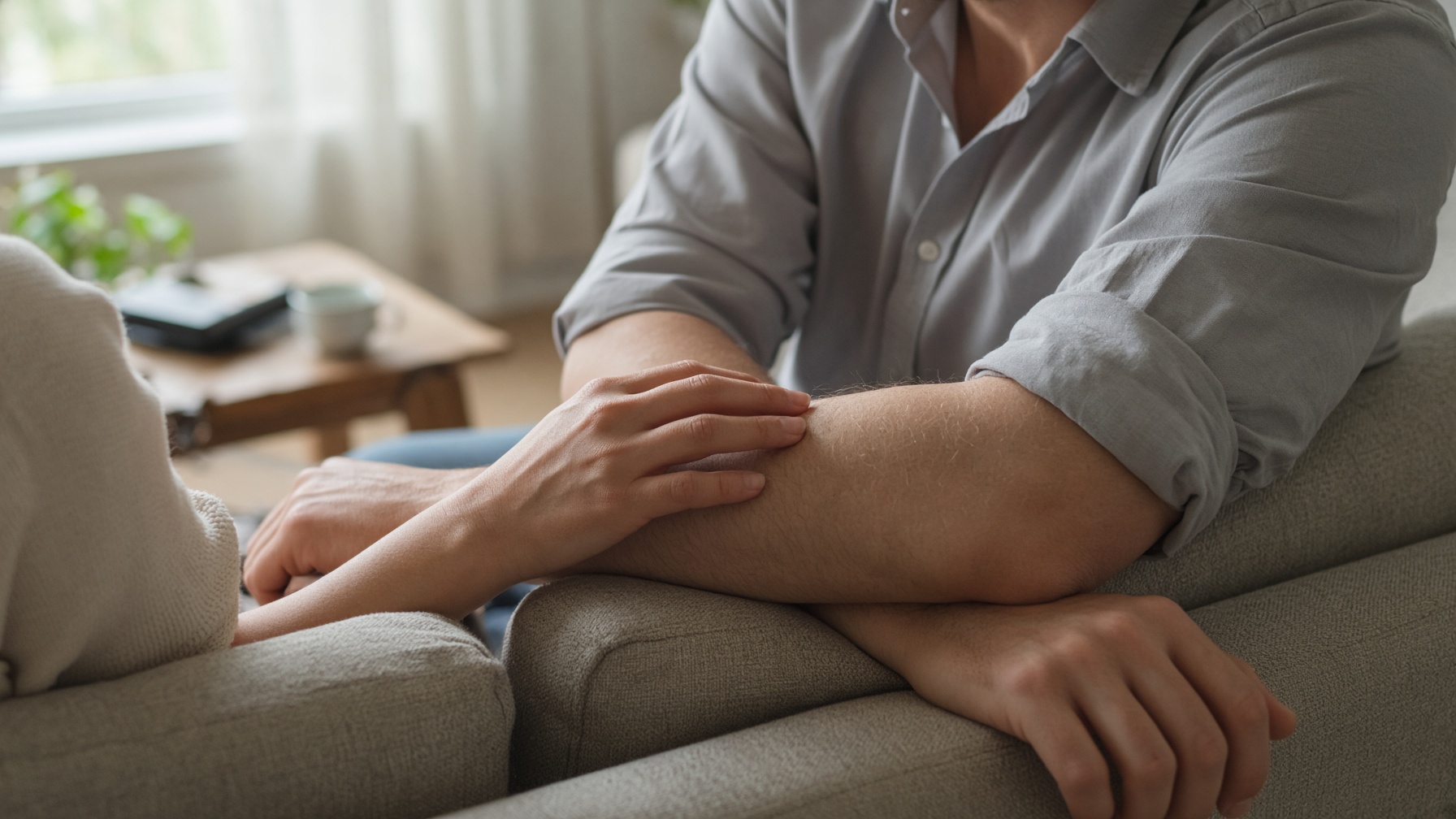
A hand moving across your back can feel unhurried, playful or surprisingly abrupt. Where it moves and how firmly it presses explain part of that difference. So do how quickly it travels, whether it keeps going and the space between one movement and the next.
During sex, stimulation is often described as if its main setting were intensity, with “more” at one end and “less” at the other. Yet a light touch in a rapid, broken pattern can feel different from a light touch that continues smoothly. Similar pressure can belong to very different experiences.
Speed and rhythm are related, but distinct
Speed is how quickly a movement happens. Rhythm is how movements and pauses are arranged in time. A quick movement followed by a long pause has a different rhythm from a slow movement repeated with almost no gap.
There is an everyday parallel in speech. Someone may say each word slowly but leave little room between sentences. Another person may speak briskly and pause often. Calling both conversations “fast” misses something about how it feels to follow them.
| Feature | What it describes | An everyday example |
|---|---|---|
| Pressure | How firmly contact is applied. | A light hand resting on a shoulder or a firmer hold. |
| Speed | How quickly a movement travels. | A hand moving slowly or briskly across the back. |
| Rhythm | The timing of movements, repetitions and gaps. | A brief movement, a pause, then another movement. |
| Continuity | Whether contact remains or breaks between movements. | A hand resting in place or lifting away during a pause. |
“Too fast”, “too strong” and “too much changing” can therefore describe separate concerns. Recognising the difference gives you more precise words for what you enjoy or would like to change.
What does research tell us about speed and timing?
Laboratory research shows that movement speed can affect how pleasant touch feels, while the interval between touches can influence where they seem to occur. These are different effects, studied with different methods.
Soft brush strokes: faster did not simply mean better
In a 2009 human study by Line S. Löken and colleagues, researchers recorded sensory nerve responses during soft brush stroking at different speeds. One group of fibres, called C-tactile afferents, responded most strongly at intermediate speeds of 1–10 cm per second. Participants also rated these speeds as the most pleasant.
The myelinated nerve fibres studied did not show the same response pattern. The finding connects a property of movement—its speed—with both a particular nerve response and reported pleasantness.
This was a controlled brush-touch experiment, not a study of sexual techniques or electronic patches. The speed range describes that experiment; it is not a recommended setting for sex. Its useful lesson is that pleasantness did not simply rise as movement became faster.
The cutaneous rabbit: timing can change perceived location
In the cutaneous rabbit illusion, rapid taps at separated places on the skin can feel as though they hop through locations in between, even when those intermediate points were never touched.
In their 2013 paper on this and related illusions, Daniel Goldreich and Jonathan Tong describe a model that combines uncertain sensory information with an expectation that stimuli tend to move slowly. It reproduces the way shorter intervals between taps can make the perceived distance between them contract.
The model also incorporates information from later touches when estimating where earlier ones occurred. This offers a vivid example of the brain interpreting a sequence across time. It concerns perceived position, rather than proving that a particular rhythm increases sexual pleasure.
How do pauses, continuity and personal preferences fit together?
A pause in movement does not have to mean a break in contact. Whether you prefer that continuity, clearly separated touches or a changing pattern is a personal question.
A hand can stop moving and remain against someone's back. If it lifts away and returns, the pause includes an absence of contact. We might call both moments a break, although they involve different events at the skin.
This helps explain how someone could enjoy unhurried movement while preferring contact to continue through the pauses. Lively movement can also happen within continuous contact. Speed alone does not tell you whether a sequence will feel flowing or broken.
Preferences can be more specific than “gentle” or “intense”
A US probability survey by Debby Herbenick and colleagues asked 1,055 women aged 18–94 about genital touching, sexual pleasure and orgasm. Participants reported varied preferences for touch location, pressure, shape and pattern.
The survey, conducted in 2015 and published online in 2017, describes a defined population. It supports recognising individual variation; it does not identify a rhythm that everyone should prefer.
Two people who both say “gentle” may be imagining different kinds of contact. One might mean light pressure; the other might mean few interruptions. “Intense” can be equally broad, describing firm pressure, rapid movement or the overall impression of uninterrupted contact.
A small clarification can make a preference easier to understand: “The pressure feels good; I'd like the movement slower,” or “I like it when your hand stays there during the pause.” These are examples of language you can adapt, rather than a script to follow. Either person can ask for a change or stop.
A familiar gesture, arranged differently
Imagine a couple kissing while one person's hand rests on the other's shoulder. The hand moves, settles and moves again while the kiss continues. Contact at the shoulder is continuous, but movement there has its own rhythm.
In another moment, the hand lifts as they pause to smile, then returns when they kiss again. Several events have stopped and resumed together. The pressure may be just as light, but the interval is more clearly marked.
One version might feel flowing; the other might feel playful. Neither requires a dramatic change of activity. Much of the difference is already in the timing of a familiar gesture.
Where does KTRL fit as a rhythmic sensory product?
KTRL™ Portable Smart Patch adds a repeating physical sensation at the skin through controlled electrical pulses. It is a self-contained, single-use consumer electronic patch with a built-in power source.
KTRL product information — advertisement
For someone interested in a pulsed sensory format, rhythm is a feature of the sensation this product provides. Its pulses are distinct from the movement of a hand; the brush-touch and tap studies above do not establish effects for KTRL.
You can view KTRL Portable Smart Patch and choose a pack. The product page explains the Single Patch and 3-Patch Pack options, alongside suitability information.
KTRL is intended for men aged 18–60, for external skin contact only, subject to the full suitability restrictions. It is not a medical device and is not intended to diagnose, treat, cure or prevent medical conditions. Follow the printed instructions and complete user guide, including the limit of 30 minutes of cumulative powered-on time in one session. Time switched off does not count; switching on again does not reset the limit.
Frequently asked questions
Is rhythm during sex the same as speed?
No. Speed describes how quickly a movement happens; rhythm describes how movements and pauses are arranged. A quick movement followed by a long pause can have a very different rhythm from continuous quick movement.
Does slower touch always feel better?
No. The brush-touch study found greater pleasantness at intermediate speeds under its laboratory conditions. It did not establish that the slowest movement is always preferable, or prescribe a pace for sexual activity.
Can you pause without breaking contact?
Yes. A hand resting in place pauses the movement while contact continues. Lifting it away creates a break in contact as well; which feels welcome depends on the person and moment.
How can I explain that touch feels too intense?
Name the feature you want to change, if you can: pressure, speed, frequent changes or uninterrupted contact. You can also simply ask to pause or stop without having to explain the sensation precisely.
Sources
-
Löken LS, Wessberg J, Morrison I, McGlone F, Olausson H. Coding of pleasant touch by unmyelinated afferents in humans.Nature Neuroscience. 2009;12(5):547–548. Human laboratory research on soft brush stroking.
-
Goldreich D, Tong J. Prediction, Postdiction, and Perceptual Length Contraction: A Bayesian Low-Speed Prior Captures the Cutaneous Rabbit and Related Illusions.Frontiers in Psychology. 2013;4:221. A model of timing and perceived tactile location.
-
Herbenick D, Fu TJ, Arter J, Sanders SA, Dodge B. Women's Experiences With Genital Touching, Sexual Pleasure, and Orgasm: Results From a U.S. Probability Sample of Women Ages 18 to 94.Journal of Sex & Marital Therapy. 2018;44(2):201–212; published online in 2017. Survey conducted in June 2015.
-
KTRL. Portable Smart Patch product information and user guide. Brand sources for product format, pack options and use restrictions.
Sources accessed: .