
Wearable comfort depends on how a product's weight, shape, stiffness and skin contact work with your body during its intended activity. Small size and low weight are useful details, but they cannot predict comfort on their own. A watch can feel reasonable in your hand yet intrusive on your wrist; one patch edge may attract more attention than the rest of the product. Movement, contact materials and wear time complete the picture.
Updated:
What determines wearable comfort?
A wearable has to fit a moving body, rather than simply occupy a small space. Consider the product and its attachment together.
| Design factor | Why it matters | What to check |
|---|---|---|
| Weight and its distribution | A load can spread across an area or concentrate at one point. | How is the device supported, and does it sit close to the body? |
| Footprint and thickness | Length and width describe coverage; thickness describes how far the product projects. | Will its dimensions suit the intended placement and clothing? |
| Edges and attachment | A boundary, strap, clip or adhesive interface can become noticeable during movement. | How do the outline and attachment interact with bending or turning? |
| Stiffness and flexibility | Flexible sections can accommodate movement; structured sections support components and contact. | Which parts need to move, and which need to hold their shape? |
| Skin-contact materials | Material, pressure and movement all contribute to the contact experience. | What touches the skin, and what suitability restrictions apply? |
| Activity and duration | A brief task and extended wear place different demands on a design. | What use and maximum duration do the instructions specify? |
Movement changes the fit
Skin and underlying tissues change shape as a wrist turns, an elbow bends or a person sits down. A rigid section may fit one posture well and become noticeable in another. Clothing can also move across the product.
A photograph on a still model can show proportions and placement, but it cannot demonstrate how the object behaves during an activity. Flexibility can help a design accommodate movement, although it does not guarantee comfort.
A low weight does not describe every contact point
Two products with the same weight may carry it differently. One might spread the load broadly; another might concentrate it near an edge or project away from the body. The attachment affects that relationship too.
This is why a prominent edge can dominate awareness even when the overall object is light. Rounded, thin and compact are descriptions of a design, rather than promises that it will disappear from your attention.
What wearable research tells us about comfort
Research shows why comfort needs to be assessed alongside function: softness, useful performance and an enjoyable wearing experience are related but distinct.
Haptiknit: softness and support in different places
The 2024 Haptiknit study by du Pasquier and colleagues in Science Robotics describes an adjustable knitted forearm sleeve with pneumatic actuators. Its layers combine higher and lower stiffness so the actuators can transfer forces to the skin within a wearable textile.
The researchers assessed tactile performance in a three-part user study and compared results with earlier approaches. The design illustrates a practical principle: a soft wearable may still need support in specific places to deliver its intended signal. It does not establish that one textile construction suits every product or body location.
A review of 46 studies: usability and comfort are different questions
A 2024 scoping review by Hoff, Kitsakos and Silva in Digital Health included 46 studies of patients' experiences with wearable technology. Findings were generally positive for satisfaction and usability, while the evidence on comfort was mixed. Not every included study assessed comfort directly.
The studies involved different devices, medical situations and settings. The review did not identify a simple pattern linking positive experiences to one device type or setting. These were healthcare wearables, rather than studies of KTRL or intimate products, so they cannot establish how KTRL will feel.
The useful distinction is to ask separately: does the product serve its purpose, is it straightforward to use, and how does it feel while worn? A positive answer to one does not answer all three.
How to judge fit for your intended activity
Start with the activity and the product's instructions, then use its specifications to picture the fit. “Comfortable” is more meaningful when you know the intended setting.
Name the use: Is the product intended for a brief activity or extended wear? Do not assume a small device is suitable for wearing all day.
Check placement and movement: Consider the movements and clothing involved at the specified location. Follow the placement instructions rather than experimenting with unapproved positions to improve fit.
Read material and attachment details: Look for what touches the skin and how contact is maintained. “Soft” or “skin-friendly” cannot guarantee a comfortable experience for everyone.
Respect your response: If discomfort or irritation occurs, stop and follow the relevant instructions. A specification is not a reason to endure an unpleasant feeling.
People also differ in familiarity with body-worn objects and in what they notice. Someone who dislikes a watch may notice another wearable sooner. That response is information about the fit between person and product, rather than a test of tolerance.
Reading KTRL Portable Smart Patch specifications
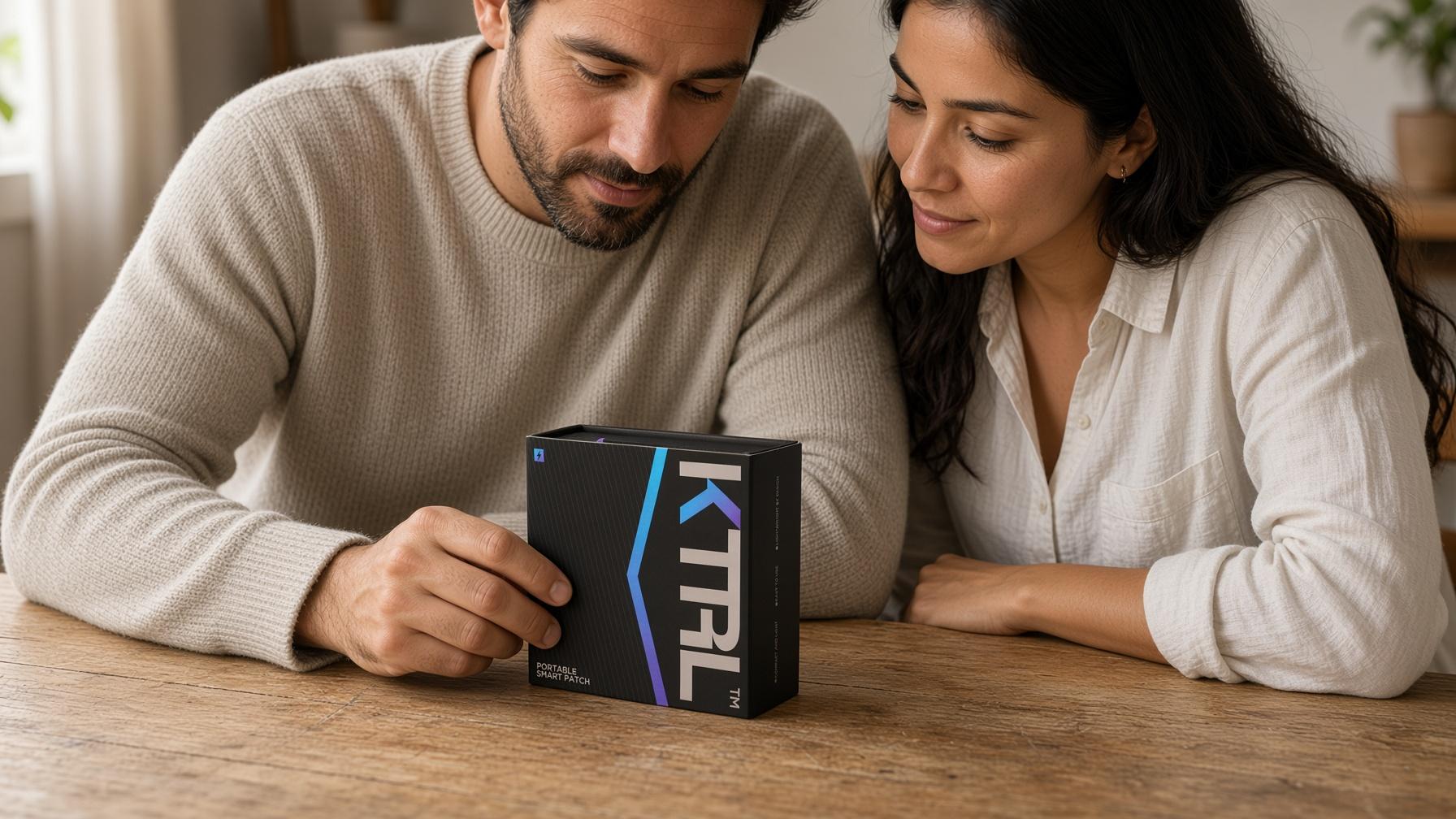
KTRL Portable Smart Patch, model WDC201, provides a concrete example of how physical specifications help describe a wearable without becoming a comfort score.
Its documented dimensions are 46 × 40 × 6 mm and its weight is 9 g. The contact materials listed in the official KTRL user guide are conductive gel and TPE insulating foam. Together, these details give a clearer picture of its footprint, thickness and skin-contact interface than a photograph alone.
KTRL uses controlled electrical pulses through external skin contact to create a rhythmic physical sensation. Its power source and controls are integrated, with no app, separate controller or charging step. This format may appeal to someone who prefers a compact product with fewer separate components to accommodate.
It is a single-use consumer electronic product for men aged 18–60, subject to all suitability restrictions. It is not a medical device and is not intended to diagnose, treat, cure or prevent disease or a medical condition.
Follow the complete guide and printed instructions. Apply only to the specified clean, dry, intact external skin and use for at most 30 minutes of cumulative powered-on time in one session. Time switched off does not count; restarting does not reset the total. Switch off before removing or repositioning, and do not reuse across sessions. The guide permits gentle bending to fit the skin, but prohibits folding or sharp bending.
If discomfort occurs, stop, switch off and gently remove the patch. If symptoms persist, do not resume use and seek professional advice. The small format does not change the instructions or suitability restrictions.
Wearable comfort comes from how weight, shape, contact and movement work together in the intended setting. Specifications help you understand that setting; the wearer's response remains essential.
Frequently asked questions
Is a lighter wearable always more comfortable?
No. Weight distribution, attachment, edges and movement also matter. A light object can still become noticeable at one contact point, so compare its shape and intended placement alongside its weight.
Why not make every part of a wearable completely soft?
Some components need structure to stay positioned or transfer a signal to the skin. Haptiknit illustrates how a wearable can combine softer and more supportive regions for a specific function.
Can a product be useful but uncomfortable?
Yes. Usefulness, ease of use and comfort describe different aspects of the experience. The 2024 healthcare review found generally positive satisfaction and usability findings alongside mixed comfort evidence.
Can KTRL be worn all day because it is small?
Its size does not make it an all-day wearable. Follow the intended use and the maximum of 30 cumulative powered-on minutes in one session; do not reuse it across sessions or continue through discomfort.
Sources
du Pasquier C, Tessmer L, Scholl I, et al. Haptiknit: Distributed stiffness knitting for wearable haptics. Science Robotics 9(97), eado3887, 18 December 2024. Original DOI; PubMed abstract.
Hoff T, Kitsakos A, Silva J. A scoping review of the patient experience with wearable technology. Digital Health, 2024. Read the open-access article.
KTRL. Portable Smart Patch product information. Product format, controlled electrical pulses and intended users. Accessed 29 October 2026.
KTRL. WDC201 user guide and specifications. Dimensions, weight, contact materials, suitability, bending instructions and cumulative session limit. Accessed 29 October 2026.