

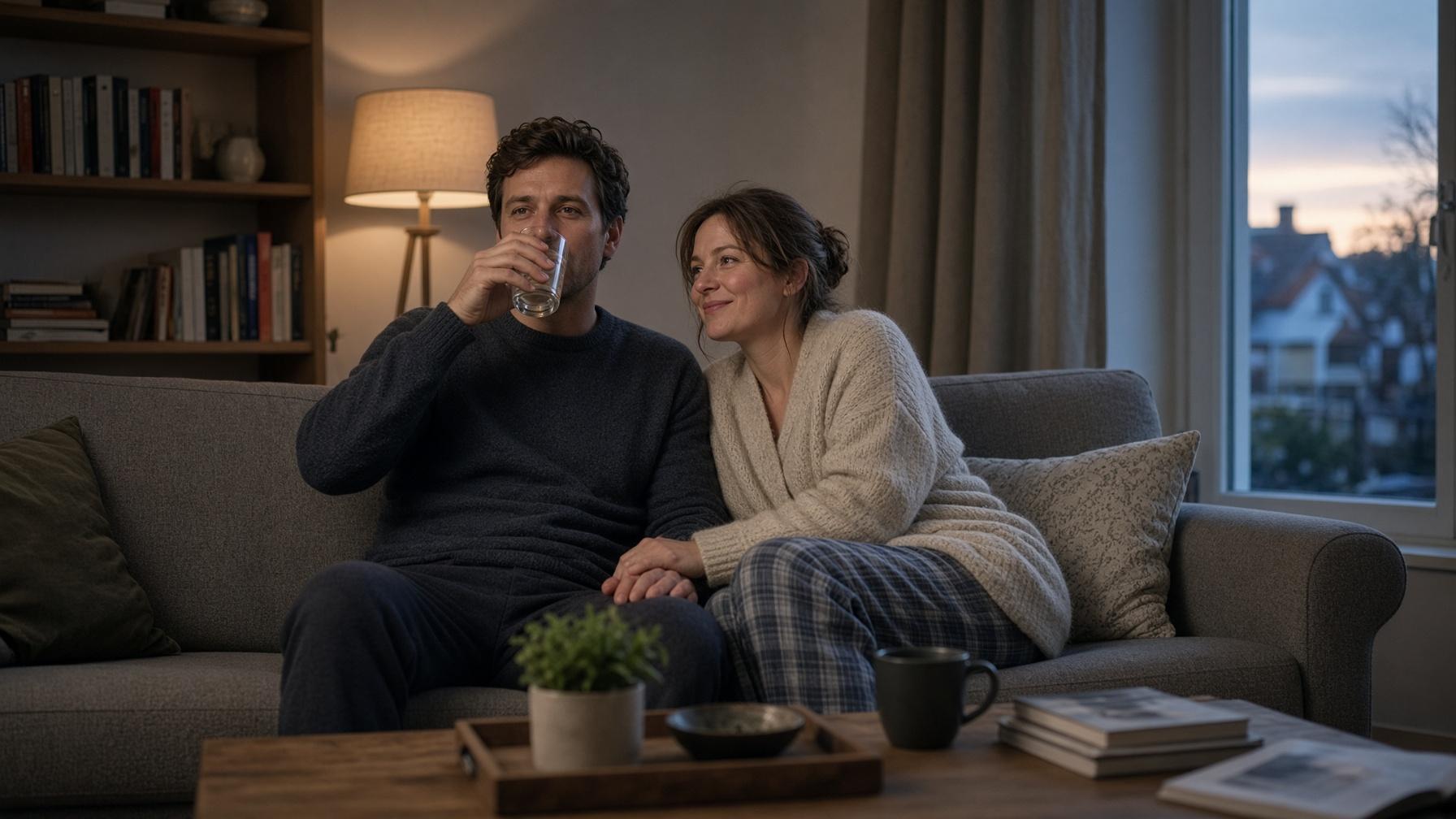
Sexual arousal can rise, settle and fall during the same encounter. Physical stimulation, attention and the surrounding situation can all influence how you feel. A quieter moment may still be pleasurable; it may also signal distraction, discomfort or a wish to stop. Separating intensity, enjoyment and what you want next is more useful than expecting excitement to increase continuously.
By KTRL | Editorial update:
Why sexual arousal fluctuates during sex
Arousal changes as your attention, sensations and circumstances change. You can be thoroughly absorbed in an intimate moment, hear your phone vibrate and suddenly remember the message you meant to send. A little later, your attention returns to your partner. The encounter has barely changed, but the way you feel has.
Many familiar descriptions of sex have a tidy shape: excitement begins, builds, reaches a climax and subsides. Films rarely make much room for someone adjusting an uncomfortable pillow halfway through. Real encounters contain pauses, laughter, conversations and decisions about what to do next.
The trouble begins when that broad outline becomes an expectation for every minute. If each moment is supposed to feel more intense than the last, a comfortable pause can start looking like a setback.
What does “plateau” mean in the sexual response cycle?
The classic sexual response cycle groups responses into excitement, plateau, orgasm and resolution. Rao and colleagues describe this historical model in their 2018 clinical guideline.
In this model, plateau describes sustained, heightened arousal before orgasm. It can be pleasurable in its own right. The word does not mean that you are stuck or that the experience has failed to progress.
These labels offer a vocabulary for broad patterns. They are less useful as a running commentary while you try to decide which stage you should have reached. A temporary drop in excitement is not automatically a “plateau”, either: the same description of lower intensity can cover quite different experiences.
Intensity and enjoyment answer different questions
“Less intense than a moment ago” describes a comparison. “I don't like this” describes how you feel about what is happening. Sometimes both are true. Sometimes a gentler moment is exactly what you are enjoying.
The useful distinction is between how strong the sensation feels, whether you enjoy it and whether you want to continue. None of those questions needs a rising line on a graph as its answer.
The older-adult guideline cited for the historical response model is used here to explain that model’s background. It is not evidence that every age group follows a fixed sequence or that a plateau must remain constant.
How the dual control model explains changing arousal
The dual control model proposes that sexual response involves interacting processes of excitation and inhibition. People differ in their tendencies towards both, as John Bancroft and colleagues explain in their 2009 review.
The Kinsey Institute's explanation compares these processes to an accelerator and a brake. A 2023 review by Janssen and Bancroft also examines research using this framework. It helps describe variability; it does not calculate why a particular person's arousal changed at a particular moment.
Imagine being close to a partner while wondering whether the bedroom door is properly shut. Attraction and concern about privacy can coexist. If that concern takes more of your attention, you may feel less absorbed even though you are still interested in your partner.
Attention can also turn towards your own response. You were enjoying the moment; now you are wondering whether you seem sufficiently excited. Trying to have an experience while checking whether you are having it correctly can feel awkward.
These are everyday examples, rather than tests of the model. You do not need to assign a numerical amount of inhibition to a notification, a worry or a pause. Noticing what has become distracting or uncomfortable is often enough to start a useful conversation.
What to do when arousal feels quieter
Respond to how the moment feels and what you want now. “My arousal went down” can describe comfortable enjoyment, distraction, discomfort or a wish to finish, and each calls for a different response.
-
You feel comfortable and engaged. The initial rush may have settled while closeness remains enjoyable. There may be nothing to solve. You can say, “I'm enjoying this at this pace.”
-
Something has distracted you. Name it if that helps: “That notification pulled me out of the moment.” You might put the phone aside or take a pause, without setting yourself a deadline to feel excited again.
-
Something feels uncomfortable. Say what needs to change: “That position is uncomfortable; let's pause.” More intensity is not the answer to discomfort.
-
You want to stop. Say so clearly, and respect a partner who says the same. Earlier excitement creates no obligation to continue; consent can be withdrawn at any time.
A brief reflection can be enough
You do not need a minute-by-minute record. If a change leaves you puzzled, consider three questions afterwards: what happened just before it, how did the quieter moment feel, and what did you want next?
“I started thinking about tomorrow” gives you different information from “The intensity settled, but I still felt close to my partner” or “I was uncomfortable and needed to say so.” These descriptions are more useful than a general judgement that the encounter went wrong.
Think back to that vibrating phone. One interruption caught your attention; then your attention returned. Sexual arousal has room to rise, settle and shift as an encounter unfolds, and you have room to decide what you would like to happen next.
Considering KTRL as an optional sensory addition
Brand product information: The following section describes KTRL’s commercial product. The studies above do not evaluate or endorse KTRL.
KTRL Portable Smart Patch is a single-use consumer electronic product that uses controlled electrical pulses to create a rhythmic physical sensation through external skin contact. It is an optional addition for an occasion when that kind of sensation appeals to you.
Its built-in, non-rechargeable power supply means it does not need charging. You can enjoy familiar contact on one occasion and be curious about something new on another. Choosing an addition still leaves room for closeness, laughter, pauses and changing your mind.
Explore KTRL Portable Smart Patch and available packs, and read the complete user guide and suitability restrictions before use.
KTRL is intended for men aged 18–60, for external contact with clean, dry, intact skin. It is not a medical device and is not intended to diagnose, treat or prevent medical conditions. Use it for no more than 30 minutes of cumulative powered-on time in one session: time switched off does not count, and restarting continues the same total. Do not reuse it in another session. Switch it off before removal or repositioning, and stop use and remove it if discomfort occurs.
Frequently asked questions
Can sexual arousal go up and down during the same encounter?
Yes. Attention, stimulation and the situation can change during an encounter, and arousal can change with them. A temporary dip alone does not tell you whether someone is enjoying the experience or wants to continue.
Does a plateau mean something is wrong?
No. In the classic sexual response cycle, plateau refers to sustained, heightened arousal. A quieter feeling may also have other explanations, so pay attention to comfort and preference rather than trying to label every moment.
Does lower arousal mean I am no longer attracted to my partner?
Not necessarily. Attraction can coexist with distraction, privacy concerns or discomfort. A change in arousal by itself cannot establish what someone feels about their partner.
Should we keep going until excitement returns?
Continue only if everyone involved wants to and feels comfortable. You can change what you are doing, pause or stop; there is no requirement to recover an earlier level of excitement.
Sources
-
Rao TSS, Tandon A, Manohar S, Mathur S. Clinical Practice Guidelines for management of Sexual Disorders in Elderly. Indian Journal of Psychiatry, 2018;60(Suppl 3):S397–S409. Used here for its description of the historical sexual response cycle.
-
Bancroft J, Graham CA, Janssen E, Sanders SA. The dual control model: current status and future directions. Journal of Sex Research, 2009;46(2–3):121–142.
-
Kinsey Institute, Indiana University. The Dual Control Model of Sexual Response. Explanation of excitation, inhibition and individual differences.
-
Janssen E, Bancroft J. The Dual Control Model of Sexual Response: A Scoping Review, 2009–2022. Journal of Sex Research, 2023;60(7):948–968.
-
KTRL. Portable Smart Patch product information and user guide. Product characteristics, suitability and use limits.