
There is no single duration that sex should last for every couple. The often-quoted 5.4 minutes is a median from a 2005 study measuring the time from vaginal penetration to ejaculation, not the length of a whole sexual encounter. Kissing, other touch and activity afterwards were outside that measurement. Before comparing yourself with a number, check what was timed and whose experience it describes. Read the study.
By KTRL | Editorial update:

How long should sex last? What 5.4 minutes means
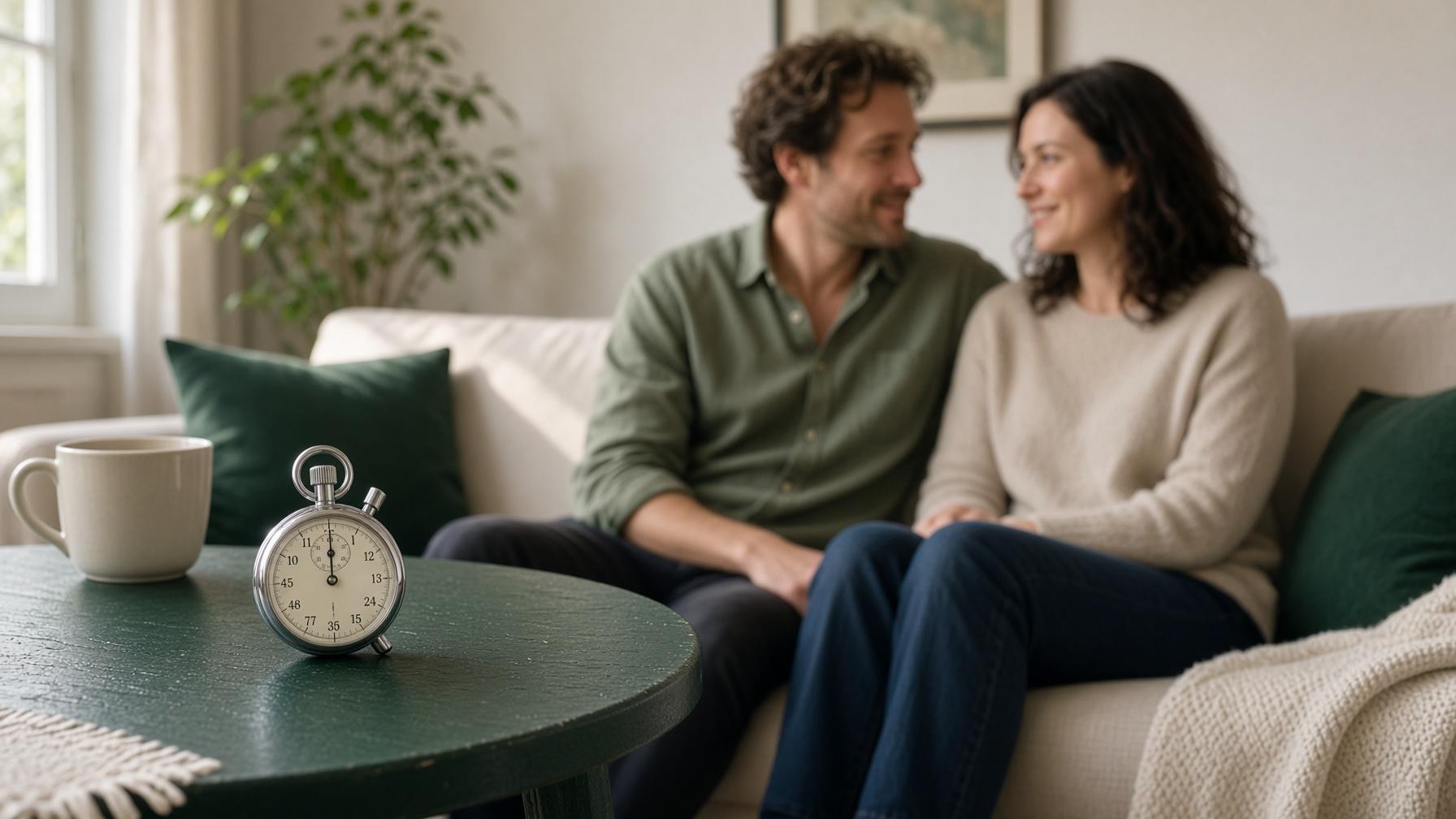
The 5.4-minute figure describes a specific interval in a particular study; it does not set a target for your sex life. Five minutes counted from the first kiss means something different from five minutes counted from penetration.
In Waldinger and colleagues' 2005 study, 500 couples were recruited across the Netherlands, the UK, Spain, Turkey and the US. The men were adults in stable heterosexual relationships of at least six months, with regular intercourse. Sexual events and stopwatch timings were recorded over four weeks. The overall median was 5.4 minutes.
Where the stopwatch starts and stops
The researchers measured intravaginal ejaculation latency time (IELT): the interval from the start of vaginal penetration to the start of ejaculation within the vagina. It excludes kissing or touching beforehand and sexual activity afterwards. It cannot stand in for the duration of other sexual activities or every kind of relationship.
Imagine ten minutes of kissing and touching, followed by five minutes of vaginal penetration before ejaculation. The whole encounter could be described as fifteen minutes, while its IELT would be five minutes. This is an illustrative example, not a research result. Both descriptions can be accurate because they count different things.
Why the median is different from the mean
A median is the middle value when measurements are put in order. The arithmetic mean is the sum divided by the number of values. Long durations can pull the mean upwards; the researchers described a distribution with a long tail towards longer timings.
For five made-up timings of 2, 3, 5, 6 and 20 minutes, the median is 5 minutes and the mean is 7.2 minutes. These numbers explain the calculation; they are not observations from the study.
Decimal minutes also need care: 5.4 minutes is 5 minutes and 24 seconds, not 5 minutes and 40 seconds. The decimal is a fraction of a minute, not a seconds display.
What the reported range can tell you
The same paper reported a range of 0.55–44.1 minutes; 0.55 minutes equals 33 seconds. Those values describe the spread of the reported data, not the boundaries of a medically approved “normal” range. Being below a median means being below the middle of that distribution. It does not, by itself, measure ability, satisfaction or a medical problem.
What the other duration studies actually asked
Measured behaviour, professional opinion and partners' preferences answer different questions. Keeping the study designs separate explains why familiar figures cannot simply be combined into a recommended total.
| Study | What it collected | How to read the finding |
|---|---|---|
| Waldinger et al., 2005 | Stopwatch IELTs over four weeks; 500 couples recruited in five countries. | The 5.4-minute median concerns penetration to ejaculation, excluding the rest of the encounter. |
| Corty and Guardiani, 2008 | American and Canadian sex therapists' opinions about intercourse duration. | “Adequate” at 3–7 minutes and “desirable” at 7–13 minutes were interquartile ranges of professional judgements. |
| Miller and Byers, 2004 | 152 heterosexual couples' reports of actual and desired foreplay and intercourse durations. | Both men and women reported wanting longer than they experienced in this sample; this gives no universal extra-time prescription. |
Does “desirable” mean you should aim for 7–13 minutes?
No. In the 2008 survey, those numbers summarised therapists' opinions. An interquartile range describes the middle half of the responses. It is not a stopwatch result, a minimum to achieve or a survey of what your own partner wants.
The labels can offer perspective, but they do not show that moving an encounter from six minutes to eight will make it more enjoyable.
Does the 5.4-minute figure include foreplay?
No. Foreplay was outside the IELT measurement. The 2004 couples study considered foreplay and intercourse separately, using participants' reports rather than stopwatch measurements. Its findings describe those respondents' experiences and wishes, not a standard for all couples.
| Evidence | What was measured or asked | How to read it |
|---|---|---|
| Stopwatch IELT study; 500 couples recruited | Time from vaginal penetration to intravaginal ejaculation; median 5.4 minutes in the reported study. | A result for the study’s population and activity, not an ideal duration for all sex. |
| Therapist opinion survey | Judgements about duration, including 3–7 and 7–13 minute categories. | Professional opinions, not stopwatch observations or targets for a couple. |
| Preference study; 152 couples | Participants’ reported duration preferences. | Preferences are distinct from measured timing and clinical diagnosis. |
How to talk about wanting more time
Ask which part of the experience someone wants more time for. “I'd like sex to last longer” could mean a more leisurely beginning, more of a particular kind of touch or a longer period of penetration. Those are different wishes.
A useful opening is: “When you say you want more time, which part do you mean?” Follow it with a question about what already feels enjoyable and what you would each like to change. Five additional minutes of something welcome and five additional minutes of something uncomfortable have the same numerical length, but very different value.
Miller and Byers found that participants' guesses about their partners' ideal durations were more closely related to their own sexual stereotypes than to what their partners actually reported wanting. That finding supports asking the person beside you instead of relying on a claim about what men or women generally prefer. See the study abstract.
When you next see an “average sex time” headline, check three things: what activity was counted, where the clock started and stopped, and whether the number came from timing, recollection or opinion. Those details often explain apparently contradictory figures.
Exploring a different sensation with KTRL
KTRL product promotion
If your shared interest is a different kind of physical contact, KTRL Portable Smart Patch is a single-use consumer electronic patch that uses controlled electrical pulses to create a rhythmic sensation through external skin contact. That gives an accessory a concrete role: exploring a sensation you are curious about.
Model WDC201 measures 46 × 40 × 6 mm and weighs 9 g. It has its own non-rechargeable battery power, so charging is not part of the routine. You can view KTRL Portable Smart Patch and available packs and check the model specifications and complete user guide.
KTRL is intended for men aged 18–60 who meet the guide's suitability requirements, for external skin contact only. It is not a medical device or a treatment for medical conditions. Follow the printed instructions and all use restrictions; do not reuse it across sessions or exceed 30 minutes of cumulative powered-on time in one session. Switch off and remove it if discomfort occurs. This is a product-use limit, not a suggested duration for sex.
How long sex should last becomes a more useful question once you know what you both want more time for. A kiss, a familiar touch or a new sensation chosen together can each matter in its own way. The stopwatch cannot choose for you.
Frequently asked questions
Is five minutes of sex too short?
Five minutes alone does not answer that question. The 2005 study reported a 5.4-minute median specifically from vaginal penetration to ejaculation. It did not establish a minimum for satisfaction or measure the whole encounter.
Is 5.4 minutes the average length of sex?
It is the study's median IELT, not an arithmetic mean or an average for every sexual activity. It equals five minutes and twenty-four seconds.
How long should foreplay last?
These studies do not establish one duration for everyone. The 152-couple study found that both men and women reported wanting longer foreplay than they experienced. Asking what kind of touch each person wants is more specific than assigning a number.
Does lasting longer necessarily mean a more satisfying encounter?
No universal rule follows from these figures. A measured duration, a professional judgement and a personal preference are different kinds of information. Consider the comfort and enjoyment of the people involved, and whether they want to continue.
Sources
The research sources below concern duration and preferences. KTRL's sources describe the product and its instructions. Links checked on 20 October 2026.
-
Waldinger MD, Quinn P, Dilleen M, et al. A multinational population survey of intravaginal ejaculation latency time.The Journal of Sexual Medicine. 2005;2(4):492–497. Stopwatch definition, recruitment, median and reported range.
-
Corty EW, Guardiani JM. Canadian and American sex therapists' perceptions of normal and abnormal ejaculatory latencies: how long should intercourse last? The Journal of Sexual Medicine. 2008;5(5):1251–1256. Therapists' opinions and interquartile ranges.
-
Miller SA, Byers ES. Actual and desired duration of foreplay and intercourse: discordance and misperceptions within heterosexual couples.Journal of Sex Research. 2004;41(3):301–309. Self-reported durations, preferences and perceptions of partners' wishes.
-
KTRL. KTRL Portable Smart Patch. Product format, electrical-pulse sensation and built-in power.
-
KTRL. WDC201 user guide. Dimensions, weight, suitability, single-use instructions and cumulative powered-on limit.