
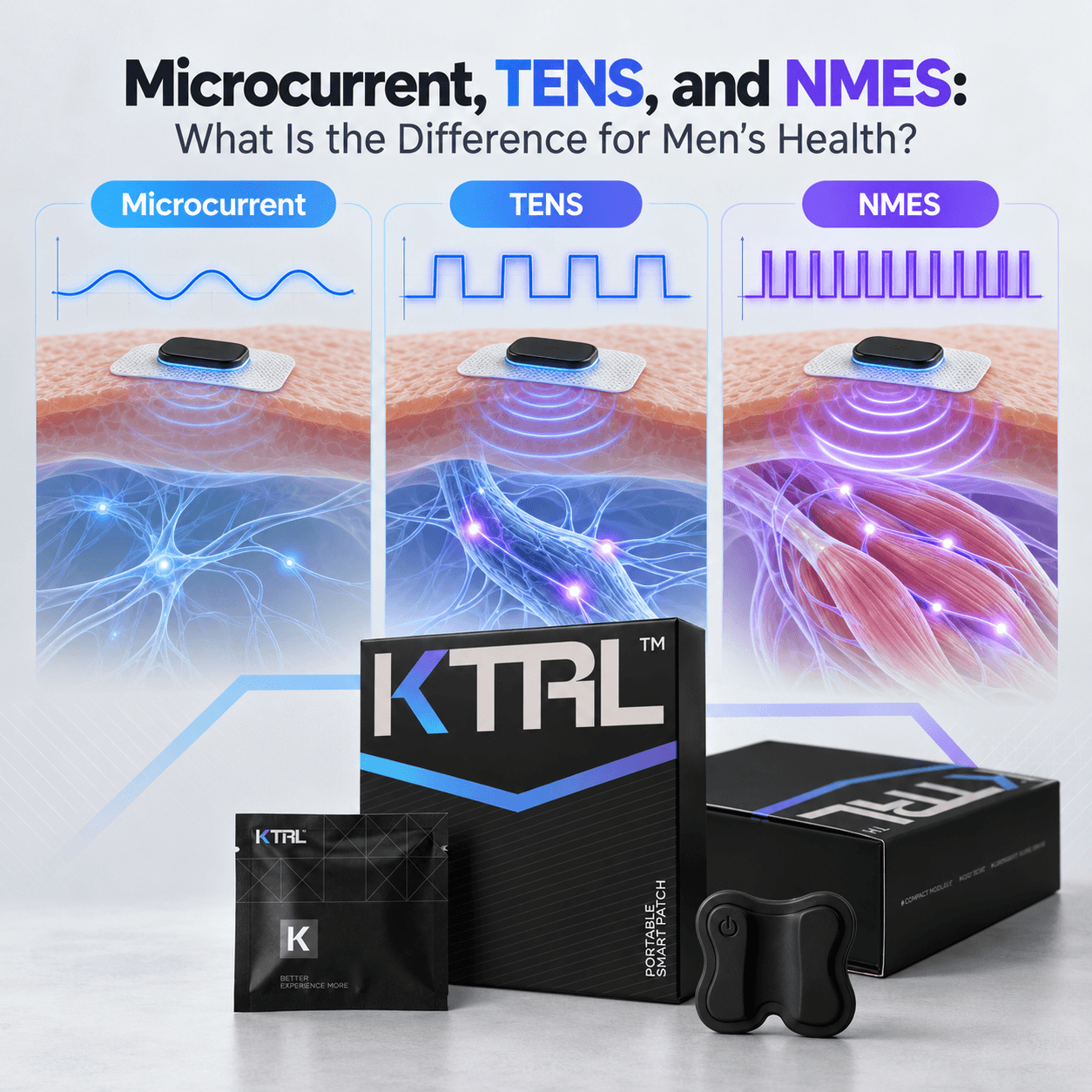
Microcurrent describes a very low electrical current; TENS describes nerve stimulation through the skin, commonly for pain relief; NMES describes stimulation intended to produce muscle contractions. These terms describe different aspects of electrical stimulation and are not interchangeable. For men's sexual health, the useful comparison is between a device's intended use, documented output, electrode placement and evidence for the specific condition. The technology label alone cannot establish a treatment benefit.
Updated:
Microcurrent vs TENS vs NMES: key differences
The distinction is between current magnitude, the route and target of stimulation, and the intended physiological response.
| Term | What it describes | What the term alone does not establish |
|---|---|---|
| Microcurrent | A low-current approach, often described as below the threshold of sensation. | A complete treatment protocol or an effective dose for a sexual-health condition. |
| TENS | Transcutaneous electrical nerve stimulation: stimulation of nerves through the skin, commonly used for pain relief. | Muscle training or a benefit for ejaculation or erectile function. |
| NMES | Neuromuscular electrical stimulation: stimulation intended to elicit muscle contractions. | Which muscles are stimulated, how they are trained or whether a particular clinical outcome improves. |
Microcurrent: a description of current magnitude
A 2023 review by Stefan Kolimechkov and colleagues describes microcurrent as sub-sensory stimulation below 1 milliampere (mA). For unit conversion, 1 mA equals 1,000 microamperes (μA). That conversion describes electrical current; it is not a recommended dose.
TENS: nerve stimulation through the skin
The NHS describes TENS as passing a weak electrical current to nerves to provide temporary pain relief. It also notes that TENS does not work for everyone. A pain-relief purpose should not be silently replaced with a sexual-health claim.
NMES: stimulation intended to produce contractions
NMES aims to activate muscles. The FDA's explanation of electrical muscle stimulators describes electrically induced contractions and clinical uses such as muscle re-education in rehabilitation. Feeling a tingle alone does not demonstrate that this type of muscle activation is occurring.
These labels can overlap in descriptions because they do not classify exactly the same property. A product's shape, a shared skin-contact format or the word “patch” does not resolve its electrical specifications or intended use.
Which electrical specifications matter?
To compare a device with a study, check the actual output and application protocol rather than relying on a category name or intensity level.
Two devices can both pass current through skin electrodes while delivering different interventions. The microcurrent review identifies variation in protocols as a major obstacle to interpreting results and calls for clearer reporting of current intensity, frequency, application time and treatment duration.
-
Current amplitude, in μA or mA: how much current is delivered. A setting called “level 3” is not a transferable electrical specification.
-
Frequency, in hertz (Hz): the repetition rate of pulses when stimulation is pulsed.
-
Pulse duration, in microseconds (μs) or milliseconds (ms): how long each pulse lasts. Microseconds measure time; microamperes measure current.
-
Waveform: whether the output is continuous or pulsed and how the signal is shaped.
-
Stimulation and rest periods: whether stimulation continues or alternates with pauses.
-
Electrode size and placement: where stimulation is delivered and over what contact area.
-
Session schedule: how long each session lasts, how often sessions occur and the total course of use.
If key details are missing, the relationship between the device and a published protocol remains uncertain. Terms such as “low frequency” or “smart stimulation” do not supply those details. This checklist helps you read documentation; it is not a set of settings to reproduce yourself.
What do the cited studies show about men's sexual health?
The studies discussed here do not establish that a consumer electrical patch treats premature ejaculation or erectile dysfunction. They investigate other outcomes, populations or interventions.
ATP findings concern an experimental tissue model
In a 1982 study by N. Cheng and colleagues, particular electrical currents increased adenosine triphosphate (ATP) concentrations and stimulated protein-related activity in rat skin. ATP is involved in cellular energy processes, but the study did not test ejaculatory control or erectile function in men.
A biological mechanism can guide further research. It cannot, on its own, establish improved sexual performance, an appropriate treatment schedule or the effectiveness of a different device.
Exercise findings remain exercise findings
The microcurrent review focuses on physiological mechanisms and exercise-related responses in healthy, physically active people. Its discussion of possible mechanisms and exercise adaptations should not be presented as clinical proof for treating a sexual-health condition.
A pelvic-pain trial tested a distinct intervention
A 2014 randomised, placebo-controlled, double-blind trial by Thomas M. Kessler and colleagues studied sono-electro-magnetic therapy in 60 men with treatment-refractory chronic pelvic pain syndrome. This combined intervention was not simply a test of any device labelled microcurrent, TENS or NMES.
After 12 weeks, the between-group difference in the primary overall symptom score was not statistically significant (p = 0.11). That result neither validates nor disproves every electrical-stimulation device. It concerns the particular intervention, patient group and outcome studied.
Pelvic pain, premature ejaculation and erectile dysfunction are different clinical problems. A claim about one cannot become a claim about another merely because both sit under “men's health”.
How to evaluate a device and its evidence
Look for a match between the intended use, the tested population, the intervention and the outcome you care about.
-
Identify the intended use. Is the product intended for pain relief, muscle activation, a lifestyle experience or a defined clinical outcome?
-
Check who was studied. Evidence about men with the relevant condition answers a different question from animal tissue, healthy exercisers or people with another complaint.
-
Match the intervention. Compare the device, output, electrode placement and schedule, not just a shared technology label.
-
Examine the comparison and outcomes. Look for an appropriate control, clinically relevant measures, follow-up and reporting of adverse events.
-
Separate immediate from lasting effects. A result during stimulation does not by itself demonstrate improvement after use ends.
A wearable example: read the product-specific description
The manufacturer describes KTRL™ Portable Smart Patch as a single-use personal lifestyle product that uses controlled electrical pulses to create a rhythmic physical sensation through external skin contact. Its stated positioning is consumer lifestyle technology, not a medical treatment.
Use the product information and KTRL user guide to check its intended use, placement and restrictions. A wearable format or the presence of electrical pulses is not enough to classify a product as microcurrent, TENS or NMES.
What should you check before use?
Follow the instructions and contraindications for the exact device and intended body area. Do not copy settings or electrode placement from a study of another device.
If the documentation does not clearly permit the intended use or placement, do not improvise. Ask the manufacturer or a qualified healthcare professional for clarification. A medical condition or an implanted electronic device makes suitability particularly important to check.
For example, NHS guidance says not to use TENS if you have a pacemaker or epilepsy. It also advises against applying TENS to irritated, broken, infected or numb skin. These are examples from TENS guidance, not a complete safety checklist for every electrical product.
“Non-invasive” and “drug-free” do not mean suitable for everyone. Stop if stimulation causes pain or skin irritation, and follow the device's stop-use guidance. Persistent symptoms or a sexual-health concern deserve appropriate medical advice rather than experimentation with intensity.
Microcurrent, TENS and NMES are useful terms when their meanings stay clear. Evaluate the intended use, documented specifications and relevant clinical evidence together. This explanation does not provide a stimulation protocol for sexual-health treatment.
Frequently asked questions
Is microcurrent just a weaker form of TENS?
That shorthand is misleading. Microcurrent emphasises current magnitude, while TENS describes nerve stimulation through the skin. Lowering an output does not establish the same clinical purpose or effect.
Does tingling mean a device is doing NMES?
No. Tingling is a sensory experience. NMES is intended to elicit muscle contractions; sensation alone does not verify that response, the device's specifications or its effectiveness.
Does microcurrent need to be felt to work?
Microcurrent is often described as sub-sensory, so it may not be perceptible. Neither feeling it nor feeling nothing proves a clinical benefit; relevant outcome data are needed.
Is a higher intensity better?
Not necessarily. More current is not a substitute for a validated protocol. Follow the device's instructions rather than increasing intensity to chase a result.
Do ATP or exercise studies prove a benefit for premature ejaculation?
No such conclusion follows from the studies discussed here. Experimental tissue and exercise findings do not establish a treatment effect for premature ejaculation in men.
Sources
-
Kolimechkov S, Seijo M, Swaine I, Thirkell J, Colado JC, Naclerio F. (2023; published online in 2022). Physiological effects of microcurrent and its application for maximising acute responses and chronic adaptations to exercise. European Journal of Applied Physiology, 123, 451–465. doi: 10.1007/s00421-022-05097-w. Full review.
-
NHS. (Reviewed 14 February 2025). TENS (transcutaneous electrical nerve stimulation). Patient guidance on purpose, use and precautions.
-
US Food and Drug Administration. (2017). Electronic Muscle Stimulators. Background on muscle contractions and rehabilitation uses.
-
Cheng N, Van Hoof H, Bockx E, et al. (1982). The effects of electric currents on ATP generation, protein synthesis, and membrane transport of rat skin. Clinical Orthopaedics and Related Research. doi: 10.1097/00003086-198211000-00045. Abstract and bibliographic record from Europe PMC.
-
Kessler TM, Mordasini L, Weisstanner C, et al. (2014). Sono-Electro-Magnetic Therapy for Treating Chronic Pelvic Pain Syndrome in Men: A Randomized, Placebo-Controlled, Double-Blind Trial. PLOS ONE, 9(12), e113368. doi: 10.1371/journal.pone.0113368. Full trial report.