

Transcutaneous electrical stimulation (TES) can create sensation through electrical pulses delivered by electrodes on the skin. Those pulses can excite sensory nerve fibres, and the nervous system processes the activity as a feeling. A patch can therefore feel rhythmic while staying still: the changing input is electrical, rather than movement from a vibration motor. The precise sensation depends on the signal, skin contact and the person.
Updated:
What is transcutaneous electrical stimulation?
Transcutaneous electrical stimulation means delivering electrical stimulation through the skin; it describes a broad approach rather than one device or one standard feeling.
In a surface-electrode system, the electronics generate a signal and conductive contacts provide the interface with the body. Electrical activity can excite sensory nerve fibres. The equipment supplies the input, while the nervous system produces the perception.
For tactile applications, you may also see the term electrotactile stimulation. A 2026 review by Sina Parsnejad and colleagues in IEEE Transactions on Biomedical Engineering describes this as a non-invasive method for peripheral nerve stimulation. Its focus is communication of information through touch.
Does an electrode have to be a needle?
No. An electrode is a conductive contact, and skin-surface electrodes sit externally. They need an appropriate interface with the skin to deliver the intended stimulation; the word electrode alone does not mean anything pierces the skin.
Why skin contact is part of the system
The skin is not a neutral sheet over the nerves. Contact area, placement and skin condition influence how current passes between electrodes and the body. The review identifies dependence on skin condition as a challenge for consistent electrotactile communication.
This explains why a device's appearance cannot tell you everything about its output. The signal and the contact interface both matter. For a consumer product, use the specified placement and skin preparation rather than assuming any location will behave the same way.
How can an electrical patch feel rhythmic without moving?
A patch can deliver a changing sequence of electrical pulses while its electrodes remain in place.
A pulse is a brief electrical event. Its duration, amplitude and shape describe aspects of that event; the spacing between pulses and any grouping into bursts describe how stimulation changes over time. Rhythm comes from the timing of the input, so visible movement is not required.
Pulse frequency and a perceived rhythm are not automatically the same thing. A device may organise pulses into a larger pattern, and a person's sensory system interprets the resulting activity. A simple description such as “pulsing” cannot specify the complete waveform.
Electrical pulses and motor vibration begin differently
| Question | Skin-surface electrical stimulation | Motor-based vibration |
|---|---|---|
| What does the device generate? | An electrical signal delivered through electrodes. | Mechanical movement transmitted through contact. |
| Must the contact surface shake? | No; the electrical input can change while the electrodes stay still. | Movement is the source of the vibration. |
| Can the input have a rhythm? | Yes, through the timing and pattern of electrical stimulation. | Yes, through changes in mechanical vibration. |
| Does “pulsing” identify the mechanism? | No. The word can describe timing in either system, so the device description must explain the mechanism. | |
Words such as tingling, tapping or fluttering may help someone describe an impression. They are not universal translations of an electrical waveform, and they cannot tell another person exactly how the same device will feel.
What can research tell us about the sensation?
Research can measure whether people detect, locate or interpret stimulation, but those results answer different questions from whether they enjoy it.
Perception includes more than noticing that something is present. A participant might detect an input but struggle to identify its location, distinguish its pattern or describe its quality. Pleasantness is another judgement again.
In a 2025 Scientific Reports study by Junyeong Lee and colleagues, 20 healthy participants received electrical and vibratory directional cues on the trunk and lower leg. The researchers compared methods for combining signals from adjacent actuators so that a sensation could be perceived between their physical positions.
Performance varied with the stimulation modality, body region and mapping method. The experiments measured continuous circle tracking and identification of discrete directions. They did not measure intimate enjoyment or test KTRL.
What this means when reading a product description
Ask what a study actually measured before applying its findings. Evidence that someone identified a direction does not establish that a different product will feel pleasant. Equally, the broad TES label does not predict one inevitable feeling: output, electrode layout and the application all need context.
The useful sequence is straightforward: the device generates a signal, the electrodes deliver it through a skin interface, neural activity occurs, and the nervous system processes that input. Each stage helps explain why devices and individual experiences can differ.
How does the KTRL patch put this principle into practice?
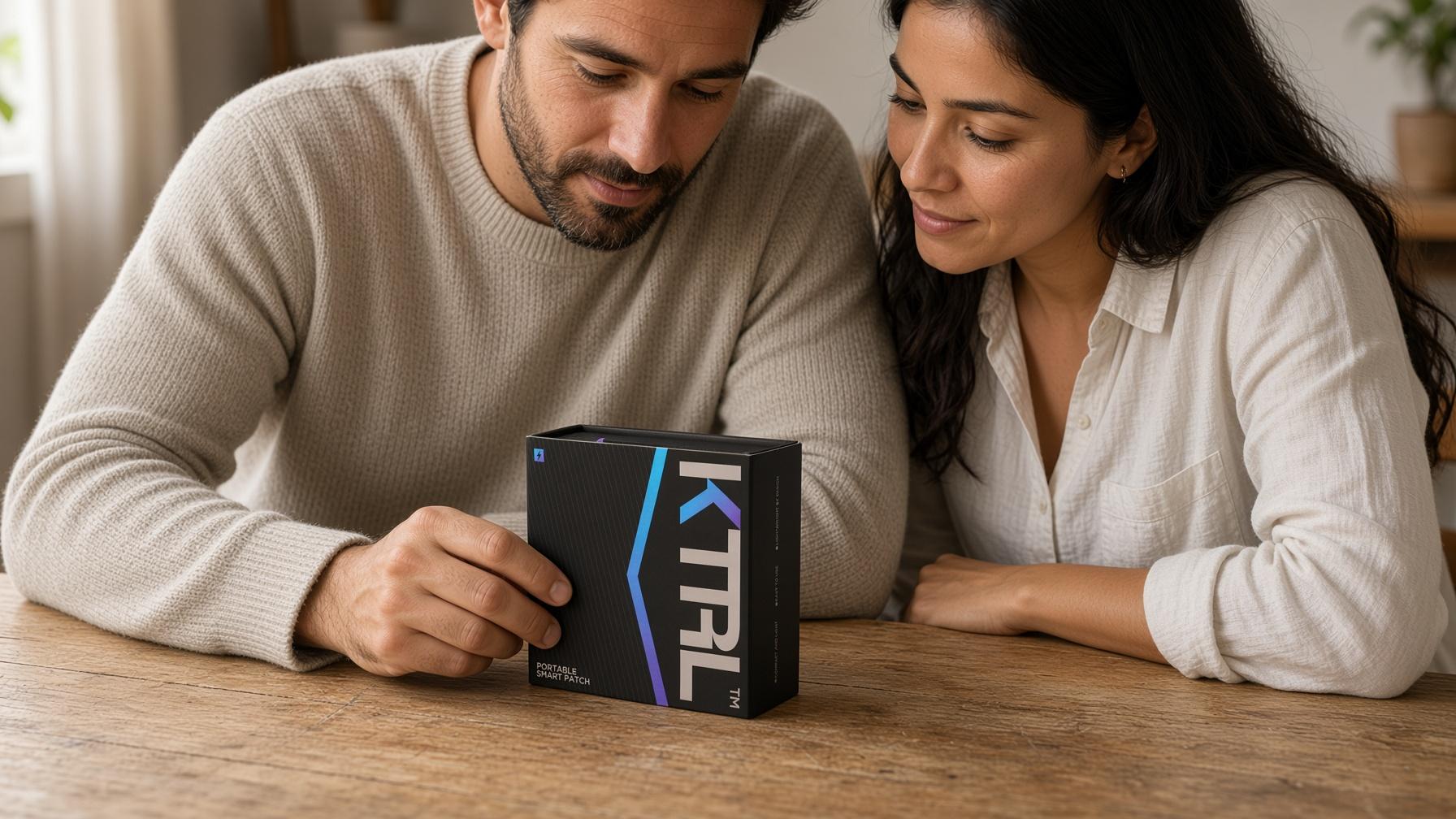
KTRL Portable Smart Patch, model WDC201, combines controlled electrical pulses, external skin contact and built-in power in a compact, single-use consumer product.
The official KTRL product description explains that the pulses create a rhythmic physical sensation. The patch does not require charging or a separate controller. The KTRL user guide lists dimensions of 46 × 40 × 6 mm and a weight of 9 g.
Separate the mechanism, format and experience
Mechanism: controlled electrical pulses delivered through external skin contact explain how the input is produced.
Format: the small dimensions, built-in power and absence of a separate controller describe how the product is carried and used.
Experience: a rhythmic physical sensation describes the intended input without determining exactly how every person will perceive it.
Keep power specifications separate from stimulation output. A battery's rated voltage is not automatically the voltage delivered at the electrodes, and its model number does not disclose pulse frequency or current. Those values require their own technical specifications.
Use the product within its stated limits
KTRL is intended for men aged 18–60, subject to the full suitability restrictions. It is for external skin contact only, is not a medical device and is not intended to diagnose, treat, cure or prevent a disease or medical condition.
Read the complete user guide and printed instructions before use. Apply only to the specified clean, dry, intact skin. Use for at most 30 minutes of cumulative powered-on time in one session; time switched off does not count, and restarting does not reset the total. Switch off before removal or repositioning, and do not reuse across sessions. If discomfort occurs, stop, switch off and gently remove the patch; if symptoms persist, do not resume use and seek professional advice.
Understanding transcutaneous electrical stimulation makes the product easier to assess: consider how it generates input, whether the physical format suits you and whether you want to explore the intended sensation. Technical terminology alone cannot decide your preference.
Frequently asked questions
Is TES the same as TENS?
TES is a broad term. TENS means transcutaneous electrical nerve stimulation and is commonly used in a pain-management context; the TES label alone does not identify a clinical purpose, muscle-training effect or particular nerve target.
Why can I feel pulses if the patch is not shaking?
The electrical input can change over time while the electrodes stay still. Your nervous system responds to that changing input, so a rhythmic sensation does not require a moving motor.
Will every electrical patch feel the same?
No. The signal, contact interface, placement and individual sensory response can differ. Descriptions such as tingling or tapping are subjective rather than a guaranteed experience.
Does a stronger sensation mean a better experience?
Intensity and pleasantness are different judgements. A more noticeable input does not establish greater enjoyment; follow the device instructions and stop if it causes discomfort.
Can battery details tell me the stimulation settings?
No. Battery type and rated voltage describe the power source. Electrode output, current, pulse duration and frequency need separate specifications.
Sources
Parsnejad S, Brascamp JW, Pelled G, Mason AJ. A review of electrotactile stimulation for machine-to-human communication. IEEE Transactions on Biomedical Engineering, 2026. Indexed abstract and bibliographic record.
Lee J, Lee H, Kim M, Kim Y, Yoon J. Comparative analysis of directional cue perception between vibrotactile and electrotactile using funneling illusion mapping methods. Scientific Reports, 19 July 2025; 15:26280.
KTRL. Portable Smart Patch: official product information. Accessed 29 October 2026.
KTRL. User guide: model WDC201 specifications, restrictions and instructions. Accessed 29 October 2026.